
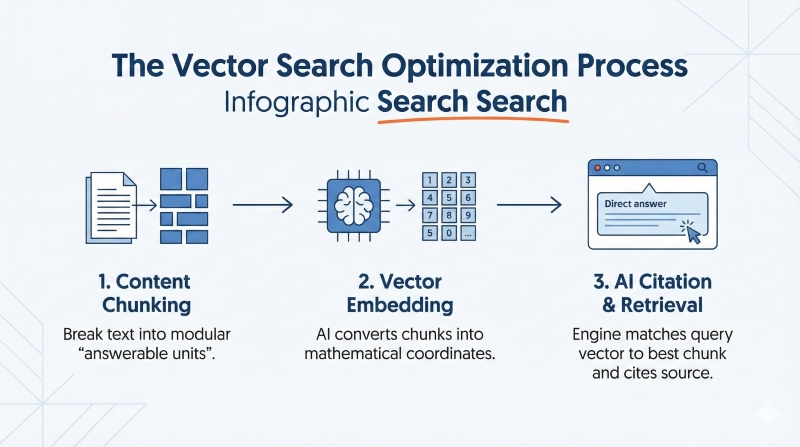
Marketing has changed because math has changed. In 2025, vector search optimization is the only defensible strategy to ensure your business and your brand are visible to AI agents. The era of matching “text strings” (keywords) is ending; the era of matching “mathematical concepts” (vectors) is here.
Quick Takeaways
- The Shift: Search engines now read “concepts,” not just words.
- The Math: Your content is converted into numbers (embeddings); similar concepts land close together in vector space.
- The Strategy: You must structure your site into “Answerable Units” to be retrieved.
- The Goal: Optimization is now about reducing the “distance” between a user’s problem and your solution in the database.
Direct Answers
What is vector search optimization?
It is the engineering process of structuring data so AI models can interpret, index, and retrieve it based on semantic meaning rather than exact keyword matches.
Why isn't traditional SEO enough?
Your content goes here. Edit or remove this text inline or in the module Content settings. You can also style every aspect of this content in the module Design settings and even apply custom CSS to this text in the module Advanced settings.
How does this help my business?
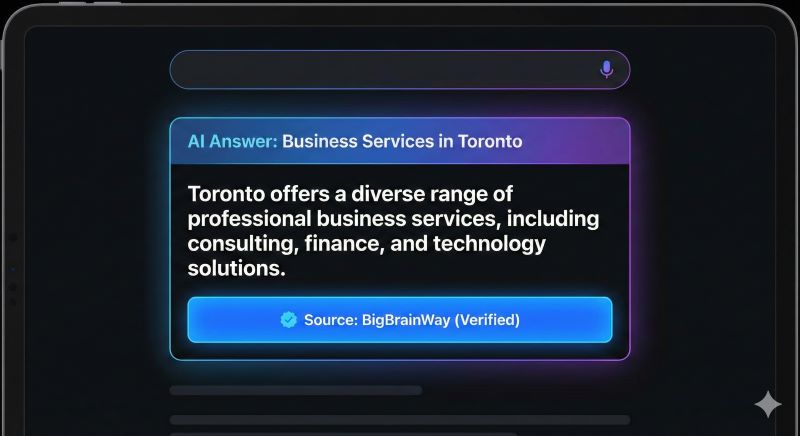
It ensures you are cited as the “source of truth” when customers ask complex questions like “who is the most reliable service provider near me?”
What is an "embedding"?
It is a list of numbers that represents the meaning of a piece of text. “King” and “Queen” have different words but very close embeddings.
The Mechanism: How Vectors Work
To understand how to rank, you must understand how the engine reads. Modern search engines do not read English; they read Vectors.
When Google or SearchGPT crawls your website, it breaks your content down and converts it into embeddings. These are multi-dimensional coordinates. If your content is “fuzzy”—meaning it mixes too many topics or lacks structure—your coordinates become imprecise.
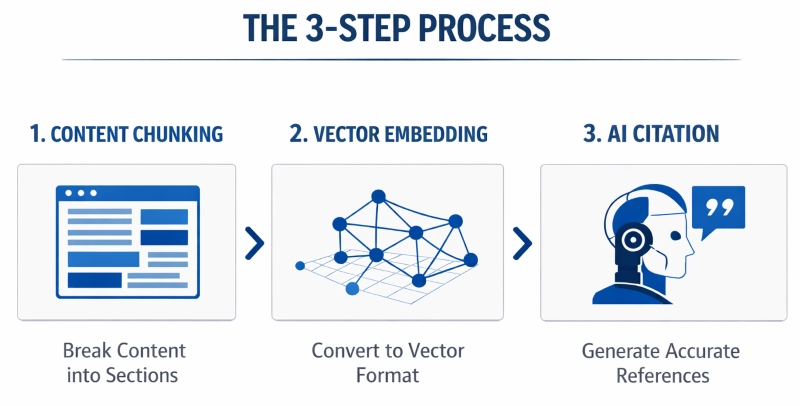
The Proximity Rule
In vector search optimization, your goal is to minimize the distance between the user’s query vector and your content’s vector. If a user searches for “emergency fix,” and your site talks about “long-term maintenance philosophy,” the mathematical distance is too great. The AI will not cite you.
The Process: Retrieval Augmented Generation (RAG)
AI answers are not “hallucinated” from thin air; they are retrieved. This process is called RAG. It happens in three steps:
- Retrieval: The AI scans its vector database for chunks of text that match the query’s intent.
- Ranking: It filters those chunks based on trust signals (Schema, E-E-A-T, Site Speed).
- Generation: It synthesizes an answer and links to the “winner.”
If your site structure blocks Step 1 (Retrieval), you never make it to Step 3 (Citation).
The Strategy: Building “Answerable Units”
You must move away from “Walls of Text” and toward “Answerable Units.” An Answerable Unit is a standalone block of HTML that answers a specific question completely.

Execution Checklist
- Headings are Questions: Don’t use “About Us.” Use “Who are the certified experts at [Company]?”
- First Sentence is the Answer: Do not bury the lead. The first 40 words must be a direct semantic match.
- Data is Structured: Use Tables and Lists. AI models can parse these faster than paragraphs.
What BigBrainWay Does
We do not guess; we engineer. Our approach to your growth is built on this vector logic.
Tier 1: The Visibility Fix
We begin by cleaning your “Entity Data.” If your business name, address, or service descriptions vary across the web, the AI loses confidence in your vector. We unify this data to create a strong signal.
Tier 2: Vector Search Optimization (VSO)
We audit your content for “drift.” We rewrite and restructure your pages into Answerable Units, ensuring that when a user asks a question in your niche, your site provides the mathematically closest answer.
Measurable Outcomes
We track success through Clean Presence and Referral Traffic. In the era of AI, “Impressions” matter less than “Citations.”
FAQ
Is VSO a replacement for SEO?
No, it is the evolution of it. Technical SEO (speed, indexability) is the foundation; VSO is the architectural design on top of it.
Can I optimize for vectors without technical skills?
It is difficult. While you can write better content, the schema markup and technical structure often require engineering expertise.
How often do vector databases update?
Major engines update their indexes constantly, but “deep” re-indexing of your site’s meaning typically happens every few weeks. Consistency is key.
Does BigBrainWay use AI to write the content?
We use AI to analyze the vectors, but we use human strategy to build the “Answerable Units” to ensure accuracy and brand voice.
- Vectors match meaning, not just words.
- Structure your site into “chunks” that answer specific questions.
- Clean entity data increases AI confidence.
- Vector search optimization is the primary driver of visibility in 2025.
The math of search has changed. Is your business adapted? Book a consultation with BigBrainWay to start your Tier 1 Visibility Fix and secure your place in the AI future.
External Links
FAISS (GitHub)
Google’s SEO Starter Guide
If you want vector search optimization implemented end-to-end, BigBrainWay builds the content structure, internal linking, and schema that AI systems actually retrieve and cite.
0 Comments