Vector Search: Unlocking the Future of Digital Presence with GEO

by Mansoor Qureshi | Jan 18, 2026 | AI Strategy, AI Strategy, Search Optimization, Growth Marketing, Article, Search Optimization

Vector Search

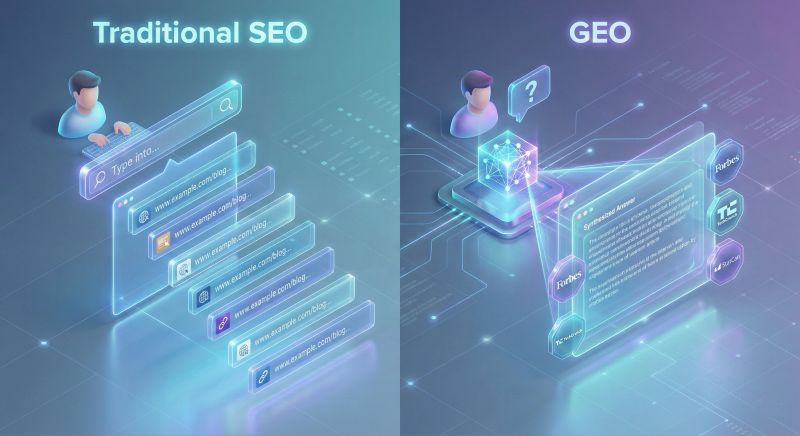
Traditional SEO

User hunts for links

GEO Model
Direct Answer
📍 Cited Source: YourBrand.com

AI delivers your brand

Fig 1. The Shift from "Blue Links" (SEO) to "Synthesized Answers" (GEO).
Table of Contents
2
3

Introduction

Generative Engine Optimization (GEO) is the strategic process of structuring content to be discovered and cited by AI-driven search engines. While traditional SEO focuses on ranking links, GEO focuses on becoming the "direct answer" provided by models like ChatGPT, Perplexity, and Gemini. As businesses upgrade their digital foundations, understanding this shift is the difference between being a search result and being the trusted expert.

Why Generative Engine Optimization Matters Now In 2026, user behavior has fundamentally shifted. According to Gartner, over 50% of search volume has moved to conversational AI interfaces, where users expect synthesized answers rather than a list of blue links. For BigBrainWay clients, this represents the "Vector Search" layer—ensuring your business data is machine-readable so AI agents can trust and recommend you.

Key Benefits of GEO

  • Citation Authority (The "40% Boost"): Seminal research from Princeton University confirms that specific optimizations—like adding relevant statistics and authoritative citations—can increase a brand's visibility in AI answers by up to 40%.

  • High-Intent "Zero-Click" Efficiency: GEO focuses on providing the direct answer. This increases lead quality because users who see your brand cited as the expert in an AI summary are already pre-qualified.

  • Scalability via Structured Data: By optimizing for generative engines, you effectively "API-ify" your content. This allows search engines and your own future [Internal Link: AI Agents] to access business data efficiently without manual re-training.

  • Cost Reduction in Acquisition: Ranking in AI summaries provides high-visibility organic reach that would otherwise require significant ad spend. StatCan reports that 12.2% of Canadian businesses have already integrated AI into their service delivery to streamline these operations.

Applications of GEO

  • Marketing (Brand Citations): It ensures your brand is mentioned when users ask qualitative questions like "Who is the best dentist in Toronto for anxiety?" rather than just "dentist Toronto" keywords.

  • Product Development: By monitoring how AI engines summarize your products compared to competitors, businesses gain unbiased insight into market perception.

  • Content Creation: Content is no longer written just for humans; it is written for machines to parse. This means shifting from long-winded intros to direct, fact-heavy "answer blocks."

Generative Engine Optimization and AI Engine Optimization (AEO) are pivotal in enhancing the performance of search engines and AI systems. Vector search, as implemented by BigBrainWay, integrates these methodologies to improve data retrieval and processing efficiency. By leveraging advanced algorithms, GEO and AEO facilitate more accurate and contextually relevant results, catering to the demands of both general audiences and professionals alike. This innovative approach not only streamlines user experiences but also empowers business owners to optimize their digital strategies effectively.

Challenges and Considerations

While this strategy offers a competitive moat, it requires a technical shift.

  • The "Black Box" Nature: Unlike Google's known ranking factors, Large Language Models (LLMs) are opaque. Optimization is probabilistic, not deterministic.

  • Data Privacy & Control: Once an AI ingests your content, you lose control over synthesis. Strong "Brand Systems" and Schema markup are your best defense to ensure accuracy.

  • Measurement Gaps: Traditional metrics like CTR apply less here. New metrics like "Share of Model" (SoM) and citation frequency are becoming the standard.

Conclusion

Generative Engine Optimization is not a trend; it is the operating system of the modern web. For local businesses and growing SMBs, the goal is simple: Be the data the AI trusts. By pivoting from "keyword stuffing" to "answer optimization," you ensure your business remains visible, credible, and actionable.

AI Search FAQ

  • What is GEO in marketing? It is the practice of optimizing web content to ensure it is cited and summarized by AI search engines like ChatGPT and Perplexity.

  • How is it different from SEO? SEO optimizes for a position in a list of links (SERP). GEO optimizes for inclusion in the single, synthesized answer generated by an AI.

  • Does this replace traditional SEO? No. It builds on technical SEO. You still need a fast, crawlable site (Tier 1), but your content strategy must evolve to include more statistics and quotes.

  • What are the most effective tactics? The Princeton study identified citing sources, adding quotations, and including statistics as the top three methods to boost visibility.

  • Why is my business not showing up in AI answers? It is likely because your content lacks "Vector Readiness"—meaning it is unstructured, opinion-based without data, or lacks the authority signals (E-E-A-T) that LLMs prioritize.

Statistics
Schema
Quotes
Processing LLM Analysis
✓ Trusted Citation
Fig 2. The GEO Optimization Layer: Feeding structure to the Machine.

Generative Engine Optimization is the strategic process of optimizing content to be discovered, cited, and synthesized by Generative Engines like ChatGPT, Perplexity, and Gemini. Unlike traditional SEO, which targets a link position, Vector Search focuses on structuring your data so AI Search models view your brand as the authoritative source for direct answers.


Generative Engines prioritize content that utilizes statistics, direct quotations, and authoritative citations. To win in AI Search, your Generative Engine Optimization strategy should focus on "Vector Readiness" ensuring your content is fact-heavy and structured. This allows Generative Engines to confidently cite your data as the correct answer for user queries.


AI Search optimization is critical because it captures "zero-click" searches where users want immediate answers. By implementing Vector Search, you ensure your brand is the one providing those answers. Without Vector Search, your business risks becoming invisible to the millions of users who now rely exclusively on Generative Engines for discovery.

0 Comments

Submit a Comment

Your email address will not be published. Required fields are marked *


Enterprise Architecture

AI Strategies for Businesses 2026: Architecting Vector Search and Enterprise Automation

Bridging the persistent gap between technological promise and operational performance.

Abstract

As enterprise technology enters a new phase of maturity, the window for superficial generative AI experimentation has definitively closed. In the contemporary economic environment, the most effective AI strategies for businesses 2026 must transcend rudimentary conversational interfaces and embed autonomous, agentic intelligence directly into the operational data infrastructure. For organizations ranging from agile small-to-medium businesses (SMBs) to large-scale enterprises, realizing tangible return on investment (ROI) now demands a rigorous, architectural approach to data management. This structural evolution is primarily driven by the transition from traditional relational databases to high-dimensional vector search optimization (VSO) and the implementation of decoupled database architectures.

This comprehensive academic review explores the macroeconomic realities of AI adoption, the technical frameworks of vector databases—specifically Hierarchical Navigable Small World (HNSW) indexing—and the governance strategies required in the modern regulatory environment. By aligning high-dimensional data pipelines with measurable business intelligence (BI) frameworks, organizations can bridge the persistent gap between technological promise and operational performance.


1. The Macroeconomic Landscape of AI Adoption in 2026

The narrative surrounding artificial intelligence has shifted from theoretical disruption to empirical, structural implementation. Longitudinal data tracking corporate technology integration reveals a profound acceleration in generative AI deployment across enterprise sectors, alongside persistent scalability challenges.

According to Statistics Canada data analyzing the trajectory of corporate technology use up to 2025 and 2026, the percentage of general Canadian businesses actively utilizing AI to produce goods or deliver services doubled from 6.1% to 12.2% year-over-year. However, this generalized figure masks deep sectoral divides. In digitally native sectors such as the information and cultural industries, the adoption rate has surged to an impressive 35.6%, followed closely by professional, scientific, and technical services at 31.7%. These sectors lead the market because their core outputs are inherently data-driven, making them prime candidates for advanced natural language processing (NLP) and machine learning integration.

Despite this aggressive rollout, a profound scalability crisis exists. Data indicates that while nearly 90% of organizations are pursuing generative AI initiatives, a fraction have successfully achieved true enterprise-scale deployment. The primary barrier to scaling these AI strategies for businesses 2026 is integration complexity and the fundamental limitations of legacy data infrastructure. To scale successfully, businesses must reconstruct their data foundations to support high-dimensional machine learning models rather than traditional relational databases.

Furthermore, the pervasive macroeconomic fear of AI-driven job displacement has proven statistically unfounded in the immediate term. Statistics Canada reports that 89.4% of businesses implementing AI saw no change in their employment levels. Instead of replacing human capital, businesses are focusing on retraining staff and redesigning workflows for higher cognitive output, utilizing AI as an augmenting layer rather than a substitute.

2. The Foundational Shift: From Keyword to Semantic Vector Search

To comprehend the mechanics of modern enterprise AI, one must first understand how machine learning models interpret and organize the world. Traditional databases—whether relational SQL frameworks or NoSQL document stores—are fundamentally deterministic. They organize data into strict rows and columns and retrieve information based on exact string matches or predefined scalar metadata. While highly effective for financial ledgers and structured inventory, this architecture is inherently hostile to the unstructured data that fuels modern business intelligence: raw text documents, audio transcripts, customer service emails, and visual media.

The structural solution, and a core pillar of robust AI strategies for businesses 2026, is the vector database.

Vector databases utilize machine learning embedding models to translate unstructured data into dense numerical arrays called vector embeddings. These embeddings represent the contextual and semantic meaning of the data across hundreds or thousands of dimensions. When a user or an autonomous AI agent queries the database, the system does not look for exact keyword overlap. Instead, it executes a mathematical similarity search—often using distance metrics like Cosine Similarity, Euclidean Distance (L2), or Inner Product—to find the vectors situated closest to the query vector in the high-dimensional space.

This transition from keyword reliance to semantic understanding is the engine that powers Retrieval-Augmented Generation (RAG). RAG allows businesses to ground pre-trained large language models (LLMs) in their own secure, proprietary data. By doing so, they effectively eliminate the risk of AI "hallucinations" while providing hyper-contextualized answers to enterprise queries. In 2026, an AI strategy that does not incorporate a vector-grounded RAG pipeline is fundamentally incomplete.

3. Deep Dive into Vector Search Structures: The Role of HNSW

The mathematical and structural integrity of a vector search engine relies on advanced algorithmic components designed to balance query speed with recall accuracy. Because scanning millions of dense vectors linearly (brute-force k-Nearest Neighbors) is computationally prohibitive in a production environment, modern vector databases utilize Approximate Nearest Neighbor (ANN) algorithms.

In 2026, the preeminent ANN indexing strategy utilized in enterprise vector databases is the Hierarchical Navigable Small World (HNSW) graph algorithm.

Understanding HNSW Algorithms

The HNSW algorithm operates by constructing a multi-layered, probabilistic graph of vector embeddings, optimizing for both rapid traversal and high recall:

The Upper Layers (Coarse Navigation): The uppermost layers of the HNSW graph contain very few data points (nodes) connected by long mathematical links. When a search query is initiated, it enters the top layer, rapidly leaping across the graph to find the general "neighborhood" of the target vector. This provides a coarse-grained overview for fast entry into the structure.

The Lower Layers (Fine-Grained Search): As the algorithm descends through the hierarchy, the graph becomes increasingly dense, with nodes connecting to their closest geometric neighbors. By the time the search reaches the foundational base layer—which contains every single vector in the database—it has already narrowed the search space exponentially.

Greedy Routing Strategy: During a query, the search starts from an entry point and follows a greedy routing strategy, moving to the closest neighbor at each layer. This closest vector becomes the entry point to the next layer down, refining the candidate set until the absolute nearest neighbors are identified.

This hierarchical structure allows vector databases to execute highly complex semantic queries across billion-scale datasets with sub-millisecond latency. For businesses, implementing HNSW-indexed vector search means their internal knowledge bases, customer support agents, and product recommendation engines can operate at human-like comprehension speeds without requiring supercomputer hardware.

4. Structural Limitations: The Memory Bottleneck of "HNSW + Float32"

While HNSW provides unparalleled search speed, it introduces significant infrastructural challenges that must be addressed in comprehensive AI strategies for businesses 2026. The dominant architectural stack in modern RAG systems relies on HNSW indexing combined with high-precision floating-point vectors (float32) and cosine similarity measurements.

This combination creates a severe operational bottleneck: the inherent trade-off between latency, throughput, and hardware costs.

Because HNSW relies on greedy graph traversal, its algorithmic efficiency is strictly contingent upon complete graph structure residency within Random Access Memory (RAM). If the vector graph is relegated to traditional disk storage (SSD/HDD), the latency of reading from disk destroys the millisecond response times required for real-time AI applications. Therefore, the industry standard forces all vectors to be kept in memory.

The cost implications of this requirement are brutal. Vector embeddings are typically encoded using single-precision floating-point (float32) representation, requiring 32 bits of storage per dimension. A dataset of one billion vectors, each containing 768 dimensions, requires approximately 3 terabytes of RAM. As enterprise data grows, the cost of provisioning continuous, high-capacity RAM for both the index and the full-precision vectors scales exponentially.

To mitigate these costs, emerging research in 2026 focuses on advanced quantization techniques (such as Product Quantization or Information-Theoretic Binarization) to compress vectors, though these methods often sacrifice retrieval accuracy. The true solution lies in fundamentally redesigning the database architecture.

5. Decoupled Architectures for Enterprise Scaling

As organizations expand their AI strategies for businesses 2026, the volume of vector data generated scales beyond the capacity of traditional, monolithic database deployments. Early monolithic vector databases struggled under enterprise loads because data ingestion (writing), indexing (organizing), and querying (reading) were inextricably linked to the same server resources. Heavy data ingestion or the computationally intensive process of building HNSW graphs would monopolize CPU cycles, causing catastrophic latency spikes for end-users attempting to query the system.

The modern architectural solution is the fully decoupled (or disaggregated) architecture.

Leading enterprise vector database frameworks have separated these operational concerns into parallelizable microservices:

The Storage Layer: Vector embeddings and index files are persisted securely in highly scalable, low-cost cloud object storage (e.g., Amazon S3, MinIO). This breaks the dependency on ultra-expensive local storage arrays.

The Compute/Query Layer: Stateless compute nodes (often utilizing RDMA-based disaggregated memory systems) load the required index files from object storage into RAM only when needed to execute a search. These query nodes can scale horizontally in milliseconds based on user traffic.

The Indexing Layer: Dedicated, resource-heavy nodes handle the computationally intensive task of building and updating HNSW graphs in the background. Because they are decoupled, this intense processing does not starve the user-facing query nodes of resources.

For businesses, this cloud-native decoupled design ensures maximum uptime and cost efficiency. It democratizes access to enterprise-grade AI infrastructure, ensuring that organizations only pay for the exact compute power they utilize during active queries, rather than paying for idle supercomputers.

6. BigBrainWay's Tier 3 Methodology: Findable to Measurable

Understanding the technical architecture of AI is only half the battle; the other half is operational integration. Advanced AI deployments must rest upon a foundation of absolute digital hygiene. An organization cannot successfully deploy an autonomous AI agent to schedule appointments or process RAG queries if its core digital assets are unstructured or unverified.

The most successful AI strategies for businesses 2026 follow a mandatory strategic progression, often modeled on tiered growth ladders.

The foundational methodology moves businesses through four distinct phases: Findable → Trustable → Actionable → Measurable.

Tier 1: Foundations (Findable & Trustable): Before introducing machine learning, the business must secure its digital footprint. This involves traditional SEO, accurate Google Business Profiles, and structured website data. If a human cannot find and trust the business, an AI agent certainly cannot.

Tier 2: Automation (Actionable): This tier introduces deterministic automations—auto-replies, standard booking sequences, and review requests. These workflows do not require complex vector search but serve to digitize operational standard operating procedures (SOPs).

Tier 3: AI & Business Intelligence (Measurable): Once the foundation is digitized, the organization transitions to deploying RAG-enabled AI agents capable of multi-step reasoning. These agents leverage vector-indexed internal data to answer complex technical queries, qualify leads, and directly execute CRM updates.

Crucially, in Tier 3, unstructured data is transformed into actionable intelligence. By piping the telemetry from AI agents and vector databases into centralized Business Intelligence (BI) dashboards, organizations can visualize exact operational bottlenecks and compute real-time ROI on their automation efforts.

7. AI Governance and Data Compliance

Deploying agentic AI over corporate vector databases requires rigorous attention to data privacy, security, and corporate governance. As AI systems gain the ability to autonomously retrieve and synthesize company data, the risk of exposing confidential intellectual property or Personally Identifiable Information (PII) increases exponentially.

Effective AI strategies for businesses 2026 must bake governance directly into the data architecture. This includes:

Role-Based Access Control (RBAC) in Vector Search: Vector databases must support metadata filtering and tenant isolation. When an AI agent executes an Approximate Nearest Neighbor search, the query must be constrained by the user's security clearance. For example, an entry-level employee querying an internal RAG system should not be able to retrieve vector embeddings generated from confidential executive financial reports.

Data Sanitization Pipelines: Before unstructured data is passed through an embedding model (like OpenAI or open-source equivalents), it must pass through a strict sanitization pipeline. This ensures that PII is redacted and never mathematically encoded into the high-dimensional space, where it becomes incredibly difficult to selectively delete.

Regulatory Compliance: Organizations must build systems flexible enough to adapt to rapidly changing legal frameworks. While national acts (such as Canada's anticipated AIDA) face legislative hurdles, regional and international data protection laws mandate strict auditability. Organizations must be able to trace exactly which vector document triggered a specific LLM generation to ensure algorithmic accountability.

8. Measuring the ROI and Pinnacle BI Integration

The disconnect between AI hype and business reality is ultimately a failure of measurement. If an AI implementation is not tracked, it did not happen. A critical flaw in early AI adoption was deploying LLMs as "cool features" without tying them to key performance indicators (KPIs) like customer acquisition cost (CAC), lifetime value (LTV), or human-hours saved.

The ultimate objective of any 2026 AI implementation must be measurable financial impact. Advanced AI strategies require the integration of AI telemetry with centralized business intelligence (BI) systems.

By utilizing vector databases and agentic AI, leadership can track precisely how many human hours were saved by RAG-enabled document retrieval, or calculate the exact revenue recovered by an AI agent handling inbound communications during off-hours. For instance, analyzing chat logs through vector similarity can reveal exactly which customer objections are most frequent, allowing the business to proactively adjust its marketing strategy.

In 2026, artificial intelligence is no longer an experimental novelty; it is a mathematical engine for enterprise scalability. By architecting robust vector search structures, implementing decoupled database processing, and enforcing strict data governance, businesses can transform their raw, unstructured knowledge into a measurable, autonomous competitive advantage.

AI Search FAQ

What are the most effective AI strategies for businesses 2026?

The core strategy is moving from basic generative chat interfaces to deploying autonomous AI agents integrated with a robust Vector Search Optimization (VSO) infrastructure. This allows businesses to ground AI in their proprietary data and connect outputs to measurable Business Intelligence (BI) KPIs.

How does a vector database differ from a standard SQL database?

Unlike SQL databases that rely on exact keyword matches in rigid rows and columns, vector databases store unstructured data (text, audio, images) as high-dimensional numerical arrays (embeddings). They retrieve information based on semantic meaning and contextual similarity rather than exact text overlap.

What is an HNSW graph in AI architecture?

HNSW (Hierarchical Navigable Small World) is a leading Approximate Nearest Neighbor (ANN) indexing algorithm used in vector databases. It organizes data into a multi-layered proximity graph, allowing the system to perform highly accurate similarity searches across billions of records in sub-milliseconds by utilizing greedy routing strategies.

Why do businesses need a decoupled database architecture for AI?

A decoupled (or disaggregated) architecture separates data storage, indexing, and query computation into different microservices. This prevents system latency during heavy data ingestion, allows for cloud-based object storage to reduce costs, and enables businesses to scale their AI operations without purchasing massive amounts of expensive RAM.

What is Retrieval-Augmented Generation (RAG)?

RAG is a framework that improves the accuracy and reliability of Large Language Models (LLMs) by retrieving relevant, factual context from an external vector database and injecting it into the model's prompt. This grounds the AI in a company's specific data and significantly reduces the risk of algorithmic hallucinations.