Executive Summary
Let’s cut through the noise. Running a business in Toronto from the bustling tech hubs of King West to the retail strips of North York is incredibly demanding. If your marketing strategy relies purely on “word of mouth” or throwing money at unvetted digital ads, you are wasting valuable capital. To scale in 2026, your business must be systemically engineered to be found, trusted, and chosen by data-driven consumers. The current regional climate requires operations to scale operational models based on economic metrics published by the Ontario Chamber of Commerce.
Purpose and Scope
This blog establishes the foundational marketing sequence required to scale any B2B, B2C, or brick-and-mortar operation within Toronto’s competitive economic zone.
Introduction
Discover what it takes to grow business in Toronto 2026 models using localized entity data structures. Running a business in Toronto from the bustling tech hubs of King West to the retail strips of North York is incredibly demanding. If your marketing strategy relies purely on “word of mouth” or throwing money at unvetted digital ads, you are wasting valuable capital. To scale in 2026, your business must be systemically engineered to be found, trusted, and chosen by data-driven consumers.
Establish the Toronto Geo-Vector to Grow Business in Toronto 2026
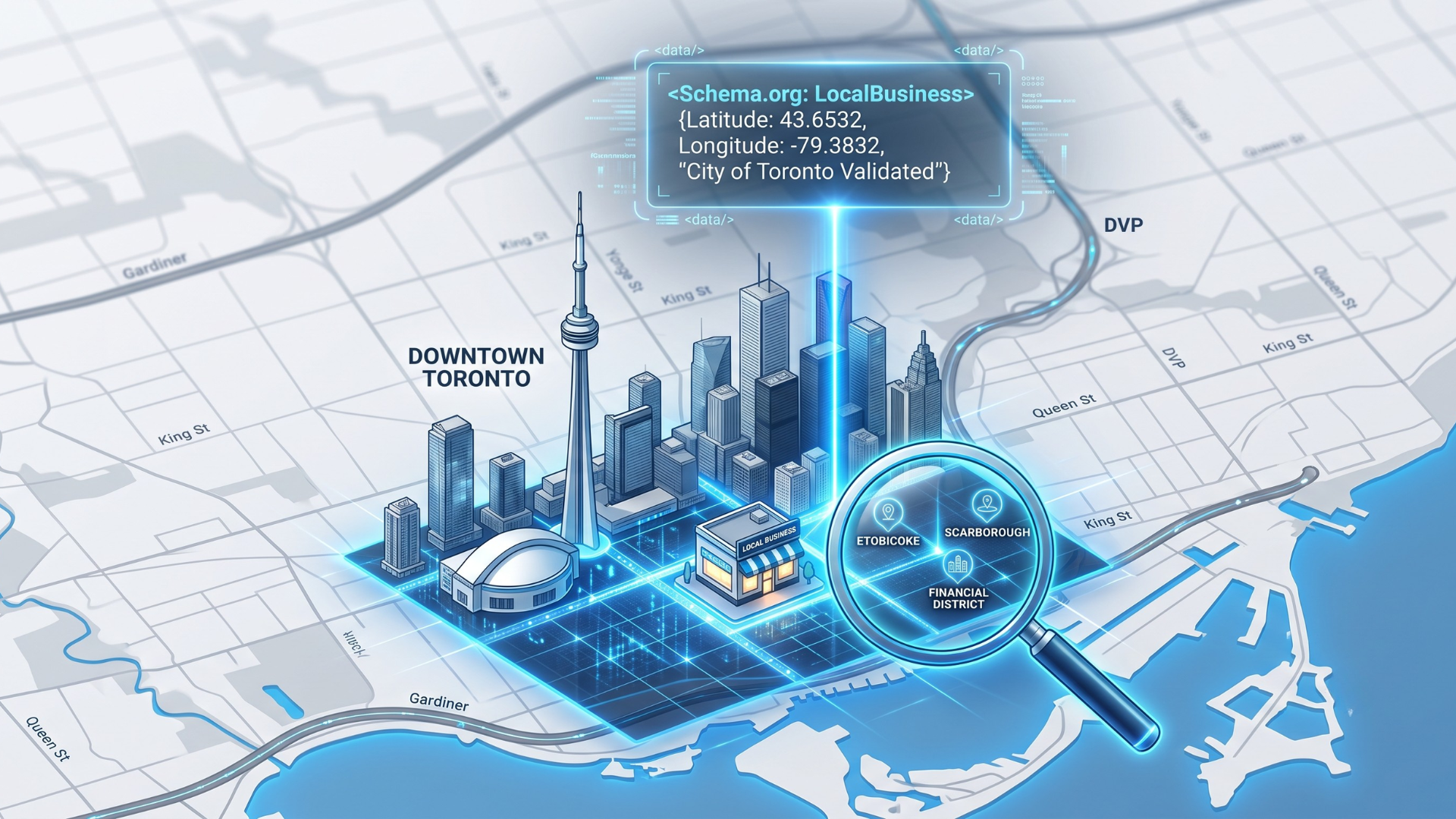
Before you spend a single dollar on advertising, your business must exist clearly within the digital mapping frameworks of the GTA. AI search engines don’t guess, they rely on hard data points. Hard-coding localized infrastructure definitions validated by the City of Toronto Open Data Portal.
- Action: Hardcode your precise latitude and longitude into your local business schema markup.
- Targeting: Don’t just target “Toronto.” Build dedicated landing hubs for distinct micro-markets like Etobicoke, Scarborough, Mississauga, and the Financial District.
Accumulate High-Velocity Local Social Proof to Scale a Business in Toronto

Toronto consumers are highly skeptical. To convert searchers into paying clients, you need local authority signals that search crawlers can index easily. To observe this vector search in active deployment, review Big Brain Way VSO framework.
- The Action: Implement an automated review acquisition framework. This system prompts clients across the Greater Toronto Area to leave feedback that names specific neighborhoods and services rendered.
- The Blueprint: A review stating “Great accounting service in North York near Yonge and Finch” carries five times the semantic weight of a generic “Best corporate tax accountant in North York near Yonge and Finch.” comment. According to metrics monitored by the Ontario Chamber of Commerce, localized consumer trust signals directly correlate with sustainable market share retention.
Optimize for the 2026 Conversational UI (The VSO Layer)

People no longer just type short keywords into search bars. They ask complex, natural questions to their voice assistants and AI engines (e.g., “Where is the closest corporate tax accountant near the CN Tower open past 6 PM?”). You must position your business natively by building a search engine compliant data structure.
- The Action: Restructure your blog content to answer these long-tail queries directly within your subheadings.
- The Execution: Use exact-match question formatting in your H3 tags. Follow them immediately with a single-sentence direct answer. This structure allows Retrieval-Augmented Generation (RAG) systems to instantly extract your business data as the definitive answer.
Conclusion
Winning the Toronto market in 2026 isn’t about outspending your competition, it’s about out-structuring them. By building a mathematically sound digital foundation that prioritizes clarity, local relevance, and deep structural data, your growth becomes predictable.
FAQs
- What is the fastest way to increase business visibility across the Greater Toronto Area (GTA) in 2026?
The single fastest method is to perform local entity search optimization rather than chasing broad national keywords. This involves hardcoding multi-location schema coordinates onto your site and establishing high-velocity review loops within target micro-markets like the Financial District, North York, and Mississauga to signal physical market density to search engines. - How do Toronto small business marketing needs differ from other Canadian markets?
The Toronto market is exceptionally dense, containing the nation’s third-largest tech and services talent concentration in North America. To scale a business in Ontario, particularly within the GTA, marketing strategies must pivot away from generic regional targeting and focus on localized long-tail question resolution to capture mobile users during high-intent commute windows. - Why is standard local SEO failing to drive leads for Toronto companies now?
Traditional SEO focuses on exact-match text density, which fails in 2026 due to the proliferation of conversational AI search interfaces. Modern engines rely on vector proximity; if your brand doesn’t possess a structured local business schema markup mapped to real municipal data nodes, AI tools will fail to retrieve your business for neighborhood queries. - How do I run a digital presence audit for a Toronto-based business?
An effective audit requires analyzing three clear data targets:
-
- Your NAP (Name, Address, Phone) consistency across local business registries.
- The distance between your target landing pages and core internal service silos.
- Your semantic validation score inside optimization tools like Rank Math to identify gaps in entity data depth.
- What role does local business schema markup play in AI search engines?
Schema acts as a clean data sheet for search engine crawlers. Instead of forcing AI systems to guess your service boundaries, explicit schema nesting declares your exact location coordinates, service hours, and geographic delivery zones, minimizing retrieval errors and maximizing selection probability. - How many local reviews does my GTA business need to rank effectively?
Volume alone is no longer the definitive metric, review velocity and contextual density dictate modern ranking shifts. To break regional ranking plateaus, deploy automation systems that systematically prompt consumers to include localized neighborhood keywords and specific service nouns natively within their organic feedback text. - What are the primary GTA market trends for 2026 that small businesses must adapt to?
The market is driven by immense tech expansion, real-time data transparency, and massive newcomer demographic growth. Businesses scaling in this environment must adopt conversational UI structures, automated lead capture pipelines, and clean digital foundations to ensure they are discovered by this evolving, highly digital consumer class.
Stop letting competitors intercept your Toronto leads. Contact Big Brain Way today to run a complete foundational audit on your local digital footprint.
Reference Links
Internal Links
- Digital mapping:
https://bigbrainway.com/optimize-google-business-profile-gbp/ - Big Brain Way VSO framework:
https://bigbrainway.com/vector-search-optimization/ - Content:
https://bigbrainway.com/social-media-content/ - Rank Math:
https://bigbrainway.com/map-authority/ - Automated lead capture pipelines:
https://bigbrainway.com/ai-automation/ - Big Brain Way
https://bigbrainway.com/
External Links
- City of Toronto Open Data Portal.
https://open.toronto.ca/ - Ontario Chamber of Commerce:
https://occ.ca/
0 Comments