
Executive Summary
Traditional SEO focused on keywords and backlinks. Today, AI engines like ChatGPT, Perplexity, and Google Gemini run on relational entities and vector math. If your website lacks structured entity mapping, AI agents bypass your site entirely. This blog outlines how Toronto business leaders can upgrade their digital infrastructure from legacy HTML to AI-understandable vector signals using proven AI SEO Toronto strategies.
Purpose and Scope
This Blog provides a complete framework for transitioning a business website from standard Google search indexing to modern Generative Engine Optimization (GEO) and Vector Search Optimization (VSO). It addresses technical schema requirements, content structuring, and local entity signals explicitly tailored for the Toronto market.
Table of Contents
Introduction
Look at your website analytics. Traffic might look steady, but a quiet shift is happening underneath. Customers in Toronto are no longer typing simple three-word phrases into a search box. They are asking AI assistants detailed, complex questions: “Which B2B IT provider in downtown Toronto offers compliance auditing with same-day response times?”
If your site relies solely on traditional 2018-era SEO tactics, stuffing keywords into headers and collecting generic backlinks, AI models will skip over you. Your site isn’t broken. It loads fast, looks great, and functions fine for human visitors. But to large language models (LLMs), your brand is completely invisible.
To win visibility today, you must optimize for vector search engines alongside traditional search crawlers.
The Root Cause: How AI Engines Read Your Website

Legacy search engines crawled text and built indexes based on word frequency. Modern AI discovery tools rely on Vector Embeddings. They convert your content into mathematical coordinates inside a high-dimensional concept space. When an AI answers a prompt, it calculates the distance between the user’s intent and your web pages. If your content lacks clear semantic relationships, your vector distance is too far. The AI chooses a competitor whose data is structured cleanly.
The AI Discovery Framework for Toronto Businesses
1. Build an Explicit Entity Graph with Schema Markup
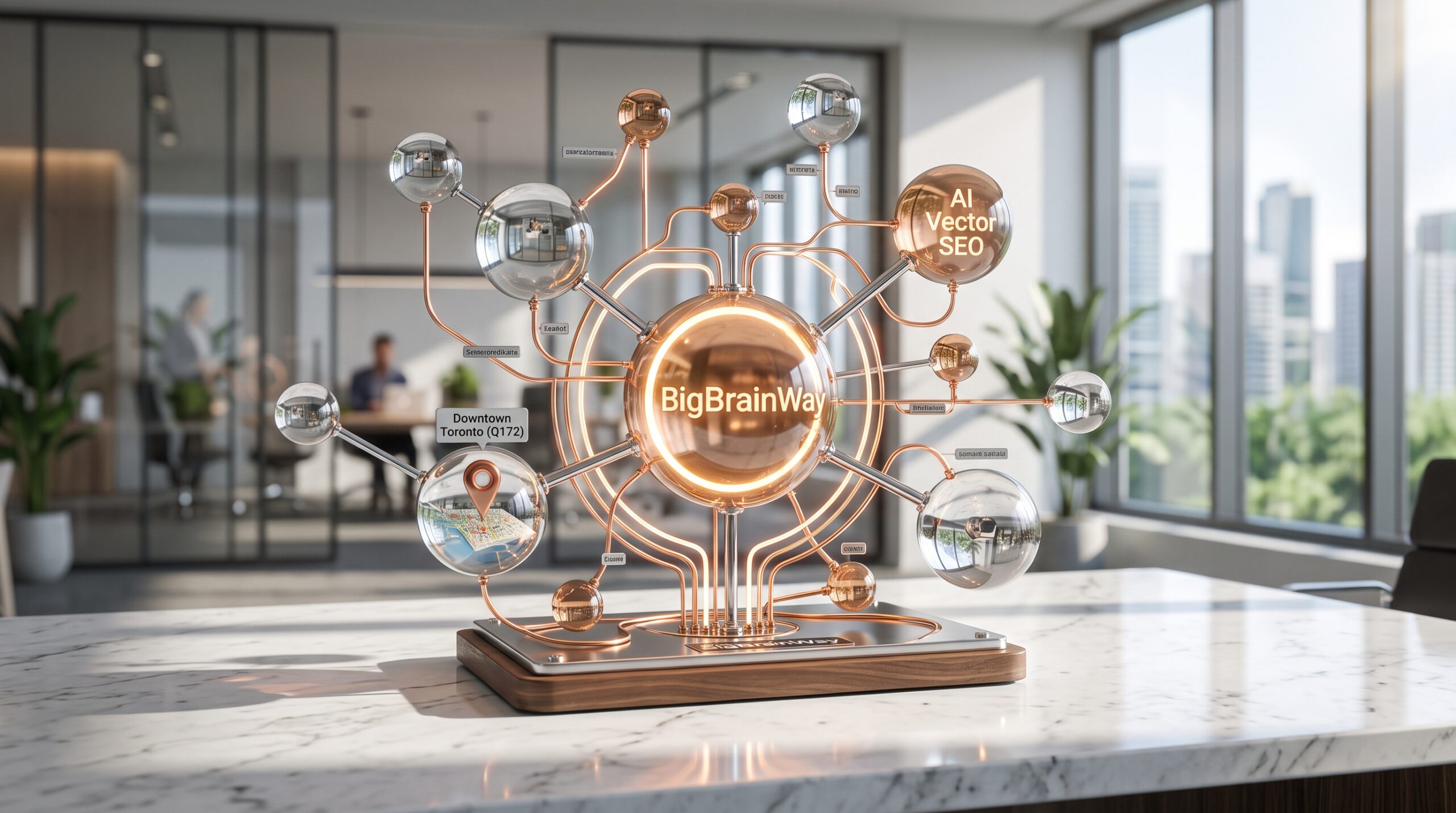
AI models do not guess your context; they verify facts. Standard HTML text requires computation to interpret. JSON-LD schema markup gives LLMs explicit data about your business directly.
To capture search queries in Toronto, anchor your site to recognized regional entities using schema properties like areaServed, geo, and sameAs.
2. Move from Keyword Density to Semantic Density

Keywords alone are no longer enough. AI models look for complete semantic clusters. If you write about AI SEO Toronto, your content must cover related entities:
- Knowledge Graphs and RAG (Retrieval-Augmented Generation)
- Structured Data & JSON-LD Validation
- Local Entity Mapping (Wikidata / Google Knowledge Panel)
- Brand Citation Velocity
3. Establish Clear Brand Authority Signals

AI systems cross-reference data across the web to verify trust before generating a recommendation. If your website claims you are a top service provider, but third-party platforms show no supporting data, the AI lowers your confidence score. Deploying Generative Engine Optimization Toronto techniques ensures cross-platform consistency across external databases.
- Core Target: Traditional SEO relies on PageRank and exact keyword strings, whereas modern AI/VSO prioritizes semantic vector similarity within concept spaces.
- Data Format: Legacy optimization targets raw HTML text and keyword placement, while modern systems require structured JSON-LD schema and explicit entity graphs.
- Verification: Historical search engines rely heavily on incoming backlinks for authority, whereas AI models verify trust through cross-platform entity matching across external knowledge bases.
- Outcome: Standard SEO aims for top blue-link positions on search engine results pages, while VSO aims for direct AI recommendations, citations, and answer-engine inclusion.
Conclusion
The shift from blue search links to direct AI answers is not a temporary trend. It is a fundamental change in how people find businesses. If your Toronto business relies entirely on legacy optimization tactics, your organic discovery channel will shrink over time.
Big Brain Way brings the exact solution by restructuring your content into clear semantic entities, deploying strict JSON-LD schema, and managing your vector presence. Through our specialized services for SMBs and vector search optimization, we ensure that AI engines discover, process, and recommend your business first.
FAQs
- What is the difference between traditional SEO and AI Vector Search (GEO)?
Traditional SEO focuses on crawling static HTML pages, tracking exact-match keywords, and calculating domain authority via inbound backlinks. AI Vector Search Optimization (GEO) converts your text into multidimensional mathematical vectors. Large Language Models (LLMs) evaluate your content based on contextual distance and cosine similarity, relying heavily on explicit JSON-LD schema markup rather than keyword frequency alone.
- Why is my well-designed Toronto website invisible to AI engines like ChatGPT?
AI engines do not view web design or visual aesthetics, they parse vector databases and structured knowledge graphs. If your Toronto business website lacks structured entity data (such as LocalBusiness or ProfessionalService JSON-LD schema), AI models cannot definitively verify your services, location, or authority causing them to drop your business from direct recommendations.
- How long does it take for Vector Search Optimization to show results?
Schema indexing and entity reconciliation usually take between 2 to 6 weeks depending on crawl frequency. Once search engines and AI crawlers parse your new JSON-LD structure, citation visibility across LLMs and local map results typically improves within 60 to 90 days as cross-platform entity signals align.
- How does schema markup impact local search visibility in Toronto?
Local schema acts as an explicit signal to AI and search crawlers. By defining properties like areaServed (referencing Toronto’s Wikidata URI) and geographical coordinates, you anchor your business to the physical location. This prevents AI models from hallucinating your service area and increases your chances of triggering local pack recommendations via our map authority framework.
- What tools should I use to verify my site’s AI visibility and schema?
You can audit your structural integrity using Google’s Rich Results Test and the official Schema.org Validator. To evaluate vector citation performance across AI models, perform prompt-probe testing across ChatGPT, Perplexity, and Google Gemini to monitor your brand’s citation share over time.
Call to Action
Stop letting AI search engines ignore your business. Contact us to schedule a comprehensive Vector & Entity Search Audit. We will uncover your website’s hidden structural issues and build a clear path to complete search visibility.

Reference Links
Internal Links
- Vector Embeddings: https://bigbrainway.com/vector-search-optimization/
- Big Brain Way: https://bigbrainway.com/
- Map Authority Framework: https://bigbrainway.com/map-authority/
- Services for SMBs: https://bigbrainway.com/bbw-services-for-smbs/
- Vector search optimization: https://bigbrainway.com/vector-search-optimization/
- Contact us: https://bigbrainway.com/contact/
- Vector & Entity Search Audit: https://bigbrainway.com/bbw-services-for-smbs/
External Links
- Toronto’s Wikidata URI: https://www.wikidata.org/wiki/Q172
- Geo: https://bigbrainway.com/map-authority/
- Rich Results Test: https://search.google.com/test/rich-results
- Schema.org Validator: http://Schema.org
0 Comments