Hook
The Search Result Is Changing
A Toronto customer no longer has to type the perfect keywords to find a local business.
They can ask a simple question:
“Who’s the best option near me?”
AI-powered search is increasingly focused on understanding the business behind the search result. It needs useful information, consistent details, genuine trust signals, helpful answers and evidence that a business can meet the customer’s needs.
That creates a new opportunity for Toronto businesses.
The goal is not simply to appear in search.
It is to become the business that search systems can confidently understand, trust and recommend.
That is the idea behind the AI Visibility Blueprint:
Findable → Trustable → Actionable → Measurable
Executive Summary
Local search is becoming more conversational and increasingly influenced by systems that understand meaning, context and relationships between pieces of information.
For Toronto businesses, this creates a practical challenge.
A business can have a website but still be difficult to discover. It can have a Google Business Profile but provide incomplete information. It can receive traffic without converting that attention into calls, bookings or leads.
The AI Visibility Blueprint provides a simple way to address these gaps.
The four layers are:
- Findable
Create a strong website, Google Business Profile and digital foundation. - Trustable
Build credibility through accurate information, reviews, original photos and consistent branding. - Actionable
Answer real customer questions and make calling, booking or contacting the business easy. - Measurable
Track visits, calls, leads, bookings and other meaningful signals so improvements can be based on evidence.
This follows BBW’s Tier 1 philosophy: fix visibility and credibility first, make the business easier to act on, and then build toward automation, AI and dashboards.
Purpose and Scope
This article explains how Toronto small and medium-sized businesses can prepare their digital presence for modern search, conversational search and AI-assisted discovery.
It focuses on practical foundations rather than promising a guaranteed position in an AI answer.
The scope covers:
- Website visibility
- Google Business Profile
- Local SEO
- Reviews and trust signals
- Original images and business information
- Customer questions and FAQs
- Conversational and semantic search
- Calls, leads and bookings
- Analytics and measurement
- The role of AI and automation after the foundation is ready
The objective is straightforward:
Make the business easier to discover, understand, trust, choose and measure.
Introduction
Search has changed from a simple keyword-matching exercise into a broader information and discovery experience.
Customers may still type keywords into Google, but they increasingly ask complete questions and expect useful answers.
For example:
Traditional search:
“physiotherapy Toronto”
Conversational search:
“Where can I find a physiotherapist in Toronto who works with sports injuries and has appointments this week?”
The second question requires more context.
A useful digital presence needs to communicate:
- Who the business is
- What it offers
- Where it operates
- Who it serves
- When it is available
- Why customers should trust it
- How customers can take the next step
BBW’s framework begins with this foundation. Its Tier 1 approach explicitly asks whether a business is findable, trustable, actionable and measurable before recommending more advanced AI systems.
The opportunity is therefore not to add AI for the sake of AI.
It is to build a digital presence that is ready to be understood by both people and modern search systems.
Why AI Search Is Changing Local Visibility
Traditional search often begins with a keyword.
Modern conversational search can begin with a complete question.
This means a business needs more than a collection of keywords.
It needs useful, connected information.
Search systems need to understand relationships between:
Business → Service → Location → Customer Need → Trust → Action
This is where semantic and vector-search concepts become relevant.
BBW describes traditional SEO as matching keywords, while vector or semantic search is concerned with meaning and relationships between concepts. Its guidance recommends conversational keyword research, FAQ restructuring, semantic markup, clean headings, internal links and structured content.
The practical lesson is simple:
Write for the customer’s question, not only the keyword.
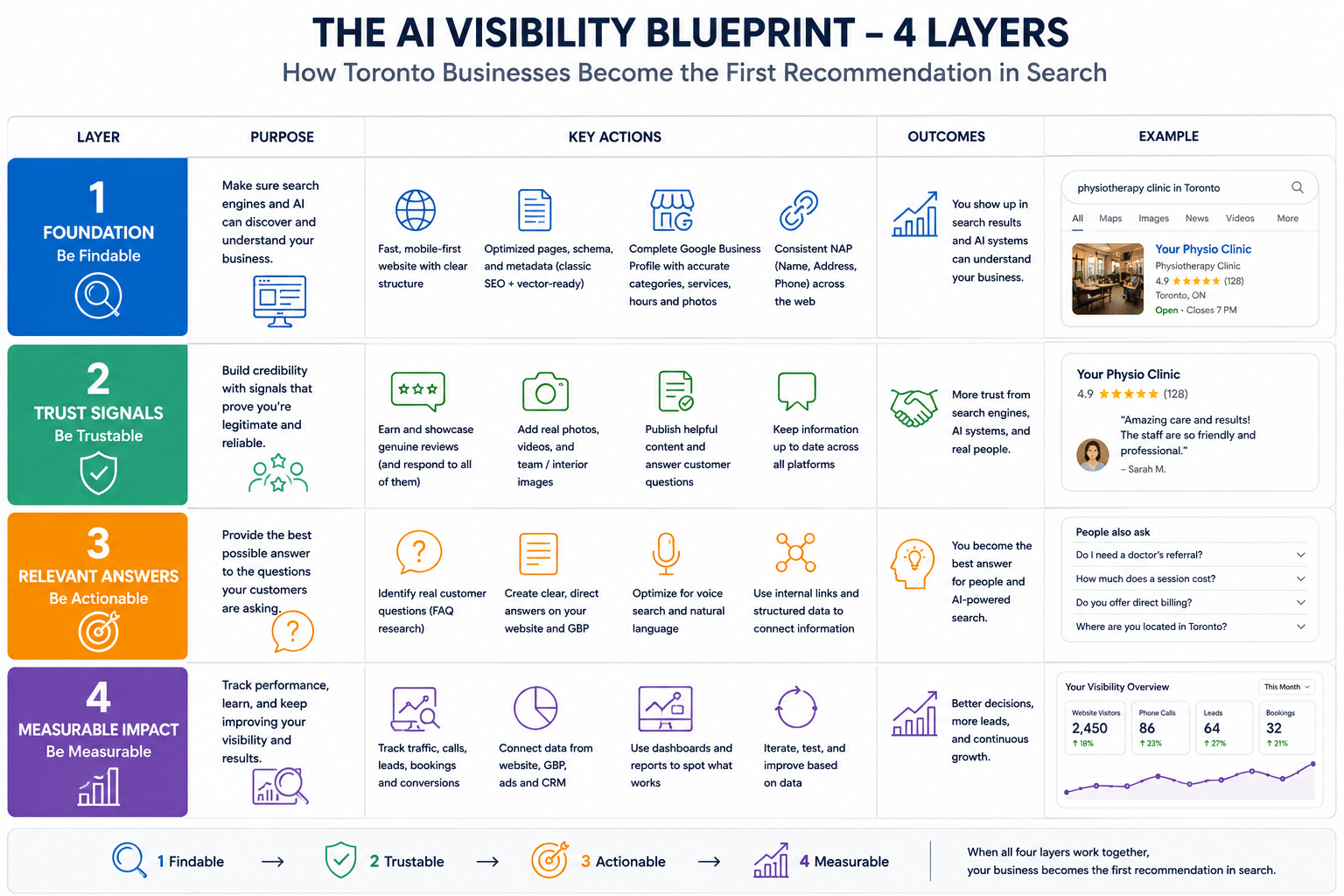
The Four-Layer AI Visibility Blueprint
The framework has four connected layers.
Layer 1: Findable
Can search systems discover and understand the business?
Layer 2: Trustable
Are there enough consistent signals to build confidence?
Layer 3: Actionable
Can a customer get an answer and take the next step?
Layer 4: Measurable
Can the business see what happened and improve?
Diagram 1: Four-Layer AI Visibility Blueprint
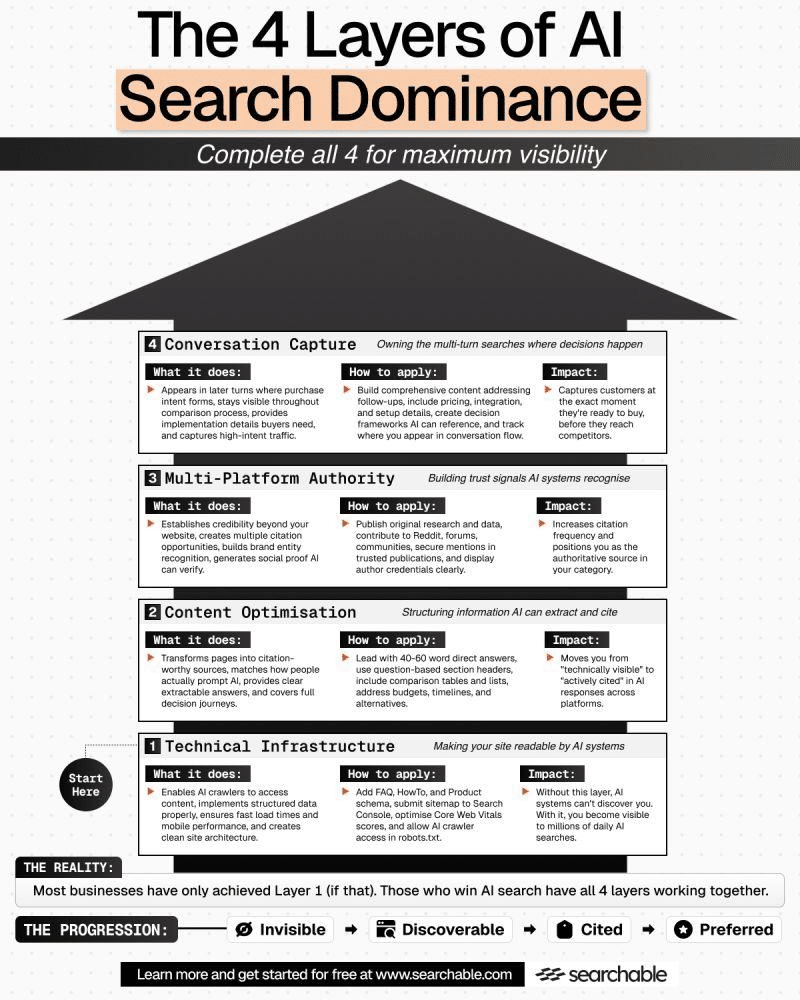
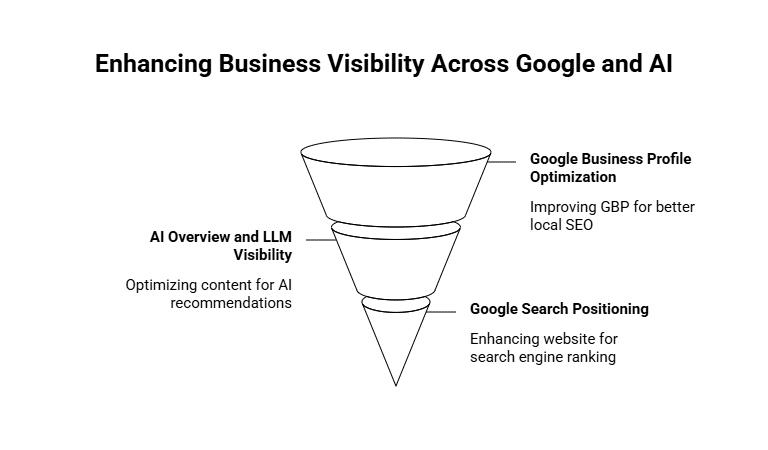
The layers work together.
A strong website without accurate business information is incomplete.
A complete profile without trust signals is weak.
Useful content without a clear action path can lose the customer.
Traffic without measurement creates guesswork.
Layer 1: Be Findable
Build a Foundation That AI Can Understand
The first layer is the digital foundation.
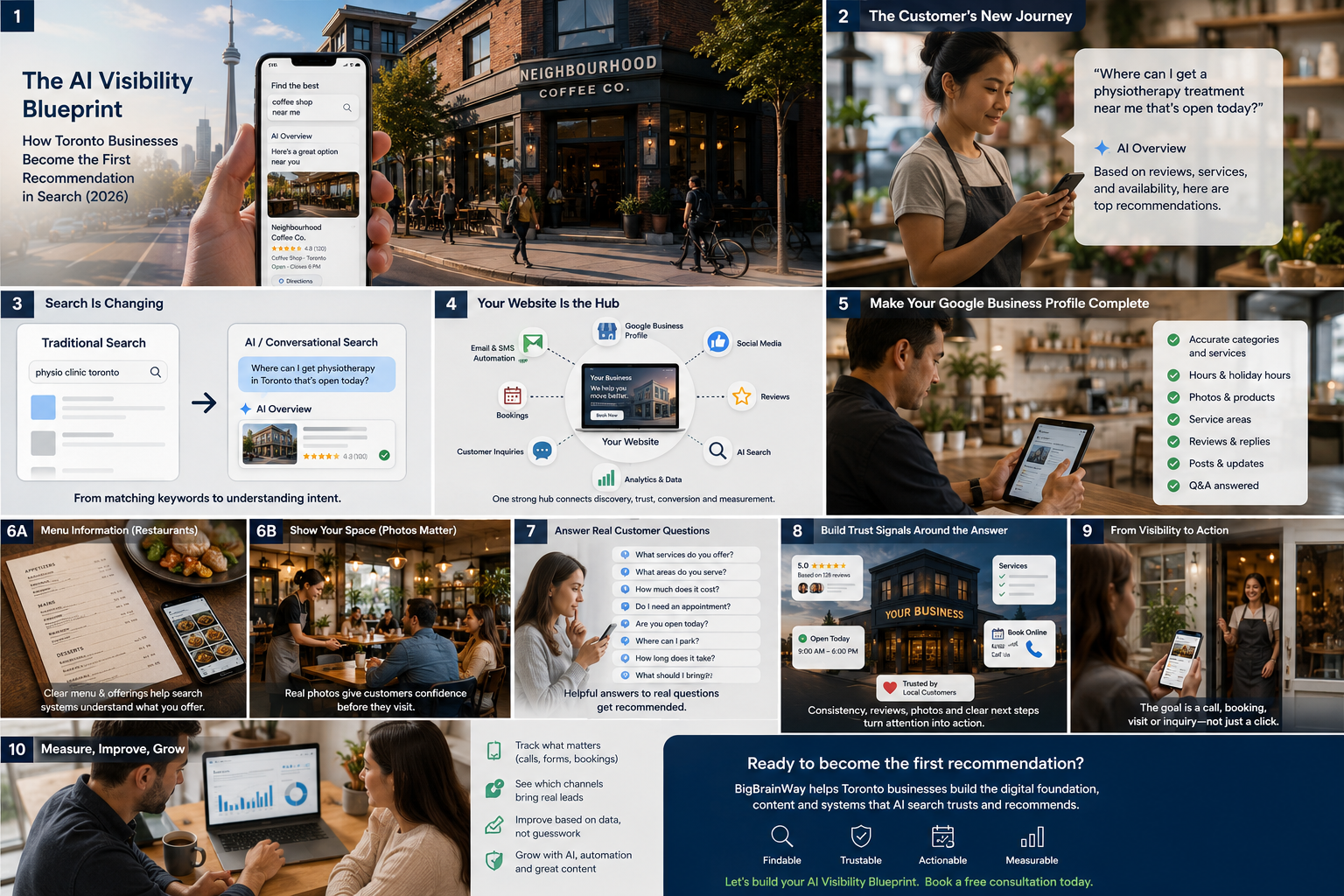
Your website is the hub
The website should act as the central home for information coming from Google, social media, advertising, email, search and future AI systems.
BBW’s Tier 1 framework identifies the website as the hub that anchors Google, social channels, reviews, booking, payments and data capture.
A strong foundation includes:
- Mobile-friendly design
- Fast loading
- Clear navigation
- Clear service pages
- Strong headings
- Contact and booking options
- Analytics
- Search Console
- Sitemap
- Appropriate schema
- Privacy and consent requirements
- FAQ content
- Internal links
The website should answer the customer’s most important questions quickly.
Google Business Profile
Your Google Business Profile should clearly communicate:
- Business name
- Address
- Phone
- Hours
- Categories
- Services
- Service areas
- Photos
- Reviews
- Posts
- Questions and answers
For restaurants, menu items and highlights can also provide useful context.
BBW’s local visibility guidance emphasizes verified profiles, accurate categories, consistent NAP information, hours, service areas, photos, products/services, reviews and ongoing activity.
Diagram 2: Website as the Digital Hub
Layer 2: Be Trustable
Build Trust Around Your Business
Being visible does not automatically mean being chosen.
Customers want proof.
Reviews
Genuine reviews provide social proof.
Respond to them professionally.
When a negative review appears, acknowledge the concern, provide a helpful response and move the conversation offline where appropriate.
BBW’s reputation framework uses the three Rs:
Respond → Remove → Recover
It also warns against defensive responses or ignoring legitimate complaints.
Consistency Builds Confidence
Your website, Google Business Profile and social profiles should agree on the basic facts.
Name → Address → Phone → Hours → Services → Branding
Consistency helps create a clearer digital identity.
Layer 3: Be Actionable
Answer Real Customer Questions
This layer turns visibility into usefulness.
Instead of asking only:
“What keyword should I target?”
ask:
“What question is the customer trying to answer?”
Examples include:
- Do I need an appointment?
- What areas of Toronto do you serve?
- How much does the service cost?
- Are you open today?
- How long does the service take?
- Where can I park?
- What should I bring?
- Do you offer online booking?
These questions can become:
- FAQs
- Service-page content
- Blog posts
- Google Business Profile Q&A
- Social posts
- Booking-page information
BBW specifically recommends blogs that answer buyer questions and internal links to service pages and booking.
Write for Natural Language
People do not always search like marketers write.
They ask questions.
They describe situations.
They use conversational language.
Your content should therefore answer the intent behind the search.
A useful answer is:
Clear + Specific + Current + Helpful + Actionable
The customer should know what to do next.
Layer 4: Be Measurable
Measure What Search Produces
Visibility is useful only when it contributes to business outcomes.
Track:
- Website visits
- Calls
- Leads
- Bookings
- Forms
- Organic traffic
- Local search activity
- Channel sources
- CRM opportunities
BBW’s measurement framework calls for GA4, Search Console, UTM-tagged links, lead/source tracking and dashboards connecting website, local search, social, CRM and AI interactions.
The question is not:
“How much traffic did we get?”
It is:
The Measurement Loop
Discover → Trust → Act → Measure → Improve
That creates a system instead of a one-time SEO project.
The Toronto Business AI Visibility Checklist
Findable
☐ Website works on mobile
☐ Services are clearly explained
☐ Location/service areas are clear
☐ Google Business Profile is verified
☐ Categories are accurate
☐ NAP information is consistent
☐ Hours are current
☐ Photos are current
☐ Website has analytics
☐ Search Console is connected
Trustable
☐ Genuine recent reviews
☐ Reviews receive responses
☐ Original business photos
☐ Consistent branding
☐ Current website information
☐ Current Google information
☐ Clear service information
Actionable
☐ Customer questions are answered
☐ FAQs are available
☐ Service pages are useful
☐ Booking/contact path works
☐ Calls-to-action are clear
☐ Internal links connect relevant pages
Measurable
☐ GA4 installed
☐ Search Console connected
☐ UTM tracking used where appropriate
☐ Leads tracked
☐ Calls tracked where possible
☐ Bookings tracked
☐ Sources recorded
☐ Results reviewed regularly
Common AI Visibility Mistakes to Avoid
Mistake 1: Starting With Advanced AI
Do not add complex AI before fixing basic digital visibility.
BBW’s model prioritizes Tier 1 first, followed by CRM, automation, AI agents and dashboards as the business becomes ready.
Mistake 2: Writing Only for Keywords
Useful content should answer customer intent, not repeat phrases.
Mistake 3: Using Generic Images Everywhere
Original local-business images create more authentic context.
Mistake 4: Ignoring Reviews
Reviews are part of reputation and customer trust.
Mistake 5: Measuring Traffic Without Business Results
Connect visibility to:
Calls → Leads → Bookings → Opportunities → Customers
How to Become a Strong Recommendation in Search
There is no single switch that guarantees an AI recommendation.
The practical objective is to build a business presence that is:
Findable
Easy to discover and understand.
Trustable
Supported by accurate information, reviews and real evidence.
Actionable
Able to answer questions and make the next step simple.
Measurable
Connected to data and continuous improvement.
The four layers create a connected system.
The website supports the Google profile.
The Google profile supports discovery.
Reviews and original images support trust.
FAQs support customer questions.
Calls and bookings create action.
Analytics and CRM data show what happened.
Then the business improves the system.
Frequently Asked Questions
What is AI visibility?
AI visibility is the ability of a business’s digital information to be discovered, understood and used within modern search and AI-assisted discovery experiences.
It includes the quality and consistency of the website, Google Business Profile, content, reviews, structured information and other relevant digital signals.
Is AI visibility the same as SEO?
No.
Traditional SEO remains important.
AI visibility expands the idea by considering how information is understood in conversational, semantic and AI-assisted search environments.
Does a Toronto business need AI to improve visibility?
Not necessarily.
The first priority is a strong digital foundation.
BBW’s Tier 1 framework recommends making a business findable, trustable, actionable and measurable before moving into more advanced AI and automation.
How does Google Business Profile support AI visibility?
A complete and accurate profile gives search systems useful information about the business, including categories, services, location, hours, photos and reviews.
Should every business create an FAQ?
An FAQ is useful when it answers genuine customer questions.
The goal is not to create artificial questions for SEO. The goal is to make important information easier to understand.
What is semantic or vector search?
Traditional keyword search often focuses on matching terms.
Semantic or vector search focuses more on meaning and relationships between concepts.
BBW recommends preparing content with conversational questions, structured information, clean headings and internal links to improve this readiness.
How do I know whether AI visibility is working?
Track meaningful outcomes such as website visits, calls, inquiries, bookings and lead sources.
BBW’s principle is straightforward:
Data or it didn’t happen.
What should a small Toronto business fix first?
Start with the foundation:
Website → Google Business Profile → Reviews → Core service content → Booking/contact → Analytics
BBW’s low-hanging-fruit ladder follows a similar priority order.
Resources and References
BigBrainWay Reference Framework
The BigBrainWay Reference Project Base File establishes the core philosophy of making local businesses findable → trustable → actionable → measurable, followed by automation and AI.
BBW Tier 1 Needs Assessment
The Tier 1 framework provides practical checklists for website readiness, Google Business Profile, content, brand consistency, conversion, compliance and data capture.
BBW AI Advisory Guide
The AI Advisory Guide covers Google Business Profile signals, reviews, NAP consistency, services, menu information, user behaviour and local visibility practices.
BBW Vector Search Guidance
BBW’s guidance explains semantic/vector search readiness through conversational keyword research, FAQs, schema, internal links and structured content.
Conclusion
The future of local search is not only about ranking for a keyword.
It is about becoming easier for both people and digital systems to understand.
For Toronto businesses, the path starts with practical fundamentals:
Be Findable.
Build the website and local profiles that clearly communicate who you are, what you offer and where you operate.
Be Trustable.
Use accurate information, genuine reviews, consistent branding and original images to build confidence.
Be Actionable.
Answer real customer questions and make the next step simple.
Be Measurable.
Track calls, leads, bookings and other meaningful signals so you can improve based on evidence.
The framework is simple:
Findable → Trustable → Actionable → Measurable
The goal is not to chase every new AI feature.
The goal is to build a digital foundation that is ready for where search is going next.
Ready to Build Your AI Visibility Blueprint?
Your business does not need more complexity for the sake of complexity.
It needs the right foundation, connected properly.
BigBrainWay helps Toronto and Ontario SMBs strengthen their digital visibility, improve customer journeys, connect data and build toward automation and AI.
Book a Visibility Conversation
If you want to understand where your business currently sits across the four layers, book a conversation with BigBrainWay.
We can discuss:
- Where your visibility foundation stands
- What may be limiting customer discovery or action
- Which digital signals should be strengthened first
- How measurement can connect visibility to business outcomes
Book a conversation:
Suggested booking CTA:
Book Your AI Visibility Conversation
Alternative CTA button:
See Where Your Business Stands
Internal Links
Add internal BBW links to relevant live pages using natural anchor text such as:
- Vector Search Optimization
https://bigbrainway.com/vector-search-optimization/
- Google Business Profile
https://bigbrainway.com/optimize-google-business-profile-gbp/
- AI Automation
https://bigbrainway.com/ai-automation/
- AI Agents
External Reference
- Google Business Profile documentation
https://support.google.com/business
- Google Search documentation
https://developers.google.com/search/updates
- Google Search Central documentation
- Google Analytics documentation
- Google Search Console documentation
0 Comments