HOOK
A potential customer visits your website, asks a question, or sends a message. Your business has earned their attention. But what happens next? If the reply arrives too late, the enquiry gets buried, or nobody follows up, the opportunity can quietly disappear.
Executive Summary
Many businesses focus on getting more website visitors, calls and social media enquiries. But generating interest is only the beginning. A business also needs a dependable way to capture, organise, respond to and follow up with potential customers.
A smarter lead follow-up system connects the website, enquiry forms, communication channels, customer records, booking process and reporting. Automation can handle routine steps, while people remain responsible for important conversations and decisions.
For Toronto businesses, the opportunity is not simply to collect more leads. It is to make better use of the enquiries they already receive.
Purpose and Scope
This article explains how small and medium-sized businesses can reduce missed enquiries and improve the journey from first contact to customer.
It covers practical lead management, CRM, customer communication, booking workflows, AI-assisted responses and performance measurement. It is relevant to service businesses, clinics, professional firms, contractors, retailers and other organisations that depend on customer enquiries.
Why do businesses lose potential customers after an enquiry?

The problem is often not a lack of interest. It is a disconnected process.
A website form may send an email that nobody checks. A social media message may sit unanswered. A phone enquiry may never reach the right team member. A quote may be sent without a reminder.
Common gaps include:
- Slow or inconsistent responses: Potential customers may move on when they cannot get a timely answer.
- Scattered enquiries: Messages arrive through email, website forms, phone calls, and social platforms, with no shared record.
- Unclear ownership: Staff members assume someone else is handling the enquiry.
- No follow-up routine: A prospect receives one reply, but nobody checks whether they need more information.
- Limited visibility: Owners cannot easily see which channels produce qualified enquiries or booked appointments.
The lesson is simple: more marketing cannot solve every growth problem. Sometimes the missing piece is what happens after someone responds to the marketing.
The five parts of a smarter lead follow-up system
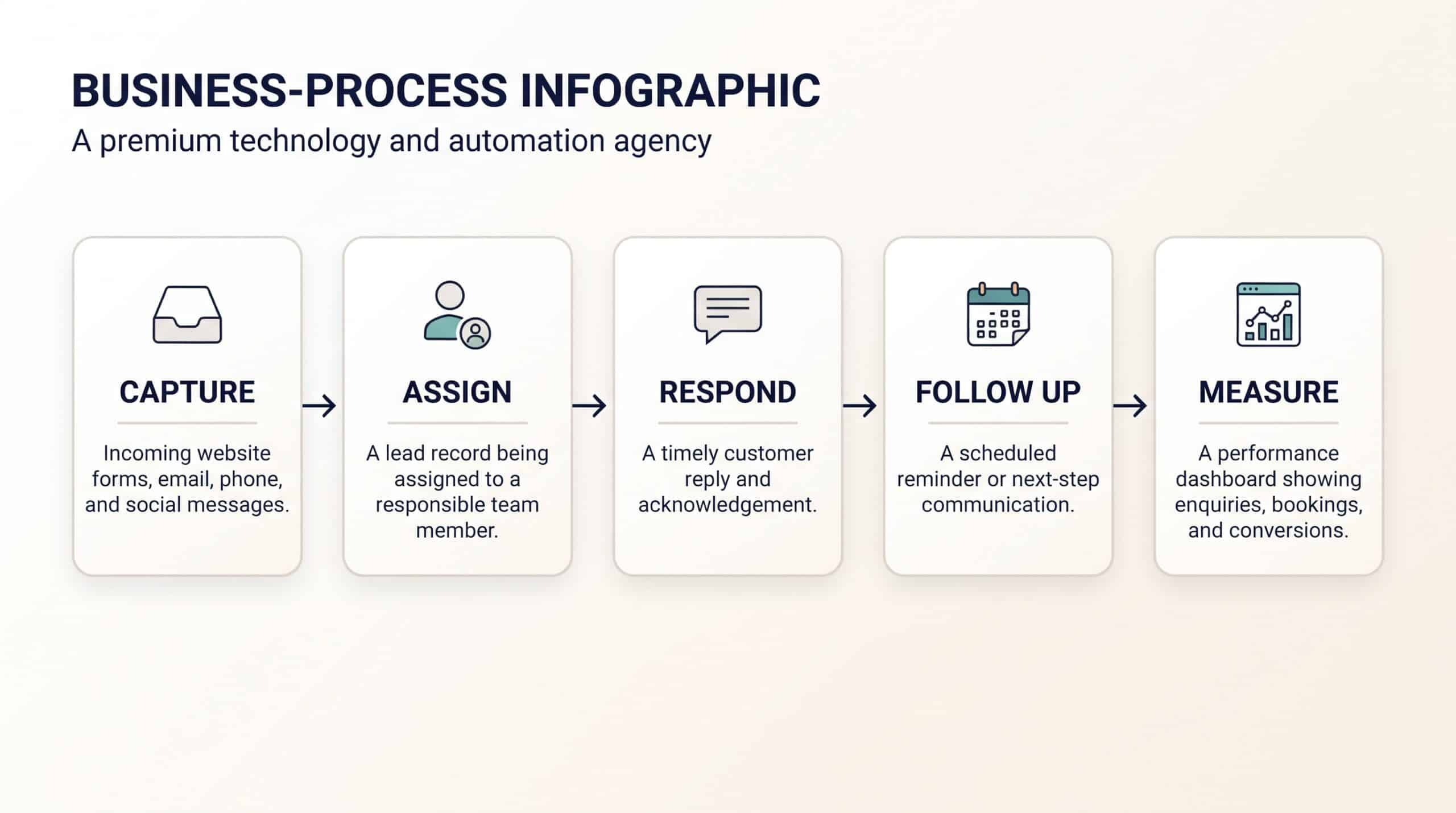
1. Capture every enquiry in one place
Start by identifying where customer enquiries enter the business.
These may include:
- Website contact and quote forms.
- Google Business Profile calls and messages, where available.
- Email and telephone enquiries.
- Instagram, Facebook and WhatsApp messages.
- Appointment and consultation requests.
A connected capture process should record the customer’s details, enquiry source, reason for contacting the business and next action. Collect only the information needed for the service and handle personal information responsibly.
2. Make responsibility clear
Every enquiry needs an owner.
A simple CRM or customer tracking system can show whether an enquiry is new, awaiting a response, in discussion, booked, converted, or closed.
This prevents messages from disappearing into individual inboxes. It also gives the business a clearer picture of its sales pipeline.
3. Respond consistently and naturally
Customers want clear answers, not robotic messages.
An automated acknowledgement can confirm that an enquiry has arrived and explain what happens next. More detailed questions can be routed to the appropriate person.
For example, a clinic may acknowledge an appointment request and direct the patient to its booking process. A contractor may confirm receipt of a quote request and ask for the essential project details.
The goal is to make the first interaction helpful while preserving a human touch.
4. Follow up with a useful next step
Not every customer is ready to make a decision immediately.
A good follow-up process may include:
- A confirmation that the enquiry was received.
- A relevant answer to the customer’s question.
- A reminder about an unfinished booking or quotation.
- A polite check-in when the customer has not responded.
- A clear way to speak with a team member.
Follow-up timing should reflect the type of enquiry, customer expectations, and applicable consent requirements. Avoid sending repeated or unwanted messages.
5. Measure what happens after the first contact
A business should know more than how many enquiries it receives.
Track:
- Number of enquiries by source.
- Time to first meaningful response.
- Percentage of enquiries successfully contacted.
- Qualified enquiries.
- Bookings, consultations or quotations.
- Enquiry-to-customer conversion rate.
- Reasons opportunities are lost.
These measures help owners identify where the process is working and where customers are dropping away.
Where do AI and automation make a difference?

AI is most useful when it supports a clear business process.
For example, an AI-assisted workflow may:
- Acknowledge incoming enquiries outside normal business hours.
- Categorise messages by topic or urgency.
- Route requests to the right team member.
- Send approved reminders and follow-ups.
- Help customers find relevant service information.
- Update CRM records and provide performance summaries.
However, automation should not make promises the business cannot keep. It should not invent prices, confirm unavailable appointments, or make sensitive decisions without appropriate oversight. Customers must have a clear route to a human when their question needs one.
Big Brain Way helps businesses connect digital experiences, lead capture, AI-enabled workflows and reporting. Its approach brings branding, technology and business intelligence together rather than treating each channel as a separate project.
What should a Toronto business do first?

Start with the customer journey you already have. Submit a test enquiry through your website, send a social message, and make a test booking request. Follow each interaction from arrival to resolution.
Ask:
- Was the enquiry received?
- Was the next step clear?
- Did it reach the right person?
- Was the response helpful?
- Was the outcome recorded?
This small exercise can reveal gaps that are difficult to notice during everyday operations.
Frequently Asked Questions
What is a lead follow-up system?
It is the process and technology a business uses to capture an enquiry, assign responsibility, respond, follow up, and track the result. It may include forms, a CRM, email, messaging, booking tools and automation.
Why are my business leads not converting?
Possible reasons include slow responses, unclear pricing or service information, poor enquiry handling, weak follow-up, booking friction, or a mismatch between the customer’s needs and the offer. Review the entire customer journey before assuming that more advertising is the answer.
Does a small business need a CRM?
Not every business needs a complex platform. A simple, consistently maintained CRM or lead tracker may be enough at first. The important thing is that enquiries have an owner, a status and a next action.
Can AI follow up with customers automatically?
AI can support acknowledgements, message classification, reminders and routine responses. The business should approve the rules, protect customer information and provide human oversight for complex or sensitive enquiries.
How can I improve customer response times?
Connect enquiry channels to a shared workflow, assign responsibility, create response templates for common questions and set internal response targets. Measure actual response times so improvements can be verified.
What should I measure to know whether follow-up is working?
Monitor enquiry volume, response time, contact rate, qualified leads, bookings, conversion rate, and lost-lead reasons. Compare results by source and over time rather than relying on total enquiry numbers alone.
Conclusion: Growth depends on what happens next
Getting discovered is important, but discovery alone does not create a customer relationship. The experience after the first enquiry matters just as much.
When a business captures every enquiry, responds clearly, assigns ownership, follows up thoughtfully, and measures outcomes, it creates a more reliable path from interest to action.
For Toronto businesses looking to grow without adding unnecessary administrative work, the next step may not be another marketing channel. It may be connecting the systems already in place.
Big Brain Way helps small and medium-sized businesses bring their brand, digital presence, AI automation, and business insights together. If your enquiries are arriving but not consistently turning into conversations, bookings or sales, it may be time to improve the process behind them.
Internal Links
Use a small number of relevant links with descriptive anchor text. Avoid inserting links simply to increase link count.
Recommended Big Brain Way internal links
|
Suggested anchor text |
Destination |
|
AI automation and intelligent agents |
|
|
Websites and conversion-focused sales funnels |
|
|
Digital infrastructure and business systems |
|
|
Learn about Big Brain Way |
|
|
Book a strategy call |
These destinations connect directly to the article’s themes of lead capture, automated communication, conversion, and operational visibility.
External References and Links
Use authoritative documentation to support the article’s technical recommendations.
- Google Search Central: AI Features and Your Website – explains eligibility, crawlability, internal links, page experience, and measurement.
- Google Search Central: Generative AI Search Guide – explains how foundational SEO supports AI-powered search and why original, useful content matters.
- Google Search Central: Helpful, Reliable, People-First Content – supports original insights, trustworthy authorship, and useful content.
- OpenAI: Publishers and Developers FAQ – publisher guidance on allowing OAI-SearchBot and ChatGPT search discovery.
- OpenAI: Make Your Website Available in Search Results – explains eligibility and crawler access for ChatGPT search.
Google’s current guidance is particularly important: AI Overviews and AI Mode do not require a separate special SEO formula or special AI schema. They rely on the same foundations of accessible, indexed, helpful content. Google also emphasises original perspectives rather than recycled generic content.
Ready to Turn More Enquiries into Customers?
Your business should not lose potential customers because messages go unanswered, follow-ups are missed, or systems do not work together.
Big Brain Way helps Toronto businesses connect their digital presence, customer enquiry channels, CRM systems, and AI-powered automation to create a smoother journey from first contact to booked business.
Whether you need better lead capture
CTA
Booking CTA
Book a Strategy Call with Big Brain Way
Ready to stop losing potential customers and build a smarter follow-up system?
Let’s discuss how AI automation, CRM, and connected workflows can help your business turn more enquiries into customers.
0 Comments