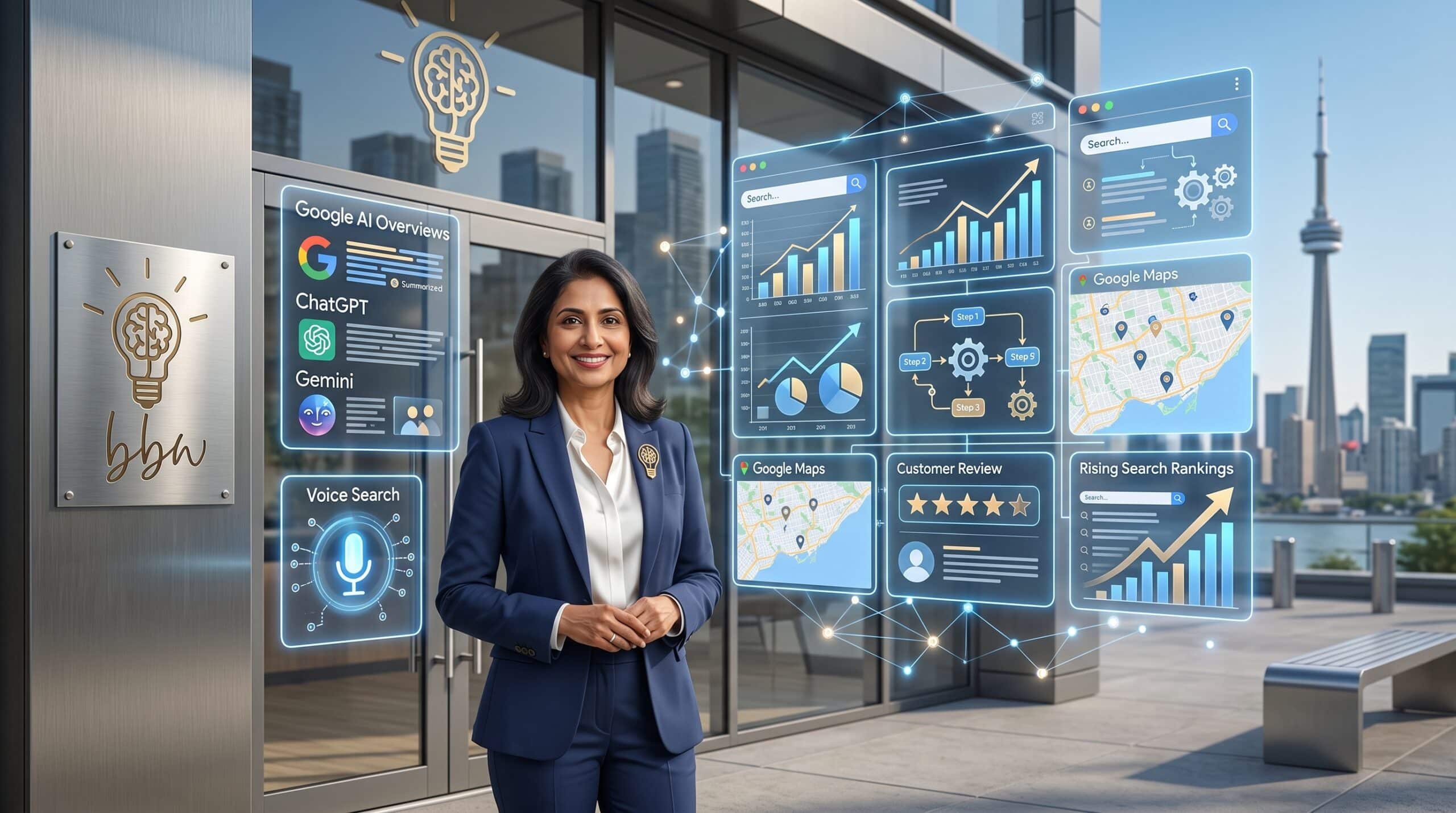
Quick Highlights
✔ Why traditional SEO alone is no longer enough
✔ How AI search engines choose businesses
✔ The importance of semantic search and entity authority
✔ Voice Search Optimization (VSO) strategies
✔ Local SEO improvements that influence AI recommendations
✔ Building trust through E-E-A-T signals
✔ AI automation that improves customer experience
✔ A practical roadmap for becoming AI-ready in 2026
Theme
How Local Businesses Can Stay Visible in the AI-Powered Search Era
The way customers find local businesses is changing quickly. People are no longer only typing keywords into Google and browsing through multiple pages of results. Increasingly, they are asking AI assistants direct questions like, “Who is the best physiotherapist near me?”, “Which restaurant should I try tonight?”, or “Who is the most trusted contractor in my area?”
This shift creates a new opportunity for local businesses. Success in 2026 will depend on being visible wherever customers search — whether through search engines, AI platforms, voice assistants, or digital recommendations.
This guide explores how businesses can combine strong SEO foundations with AI search optimization and automation to improve visibility, build trust, and connect with the right customers at the right time.
Executive Summary
Artificial intelligence is no longer changing search. It is becoming a search.
Customers are asking ChatGPT for recommendations instead of typing keywords into Google. Google AI Overviews now answer questions before users even reach traditional search results. Voice assistants deliver a single recommendation instead of presenting ten blue links. Businesses that remain optimized only for yesterday’s SEO strategies risk becoming invisible where tomorrow’s customers are looking.
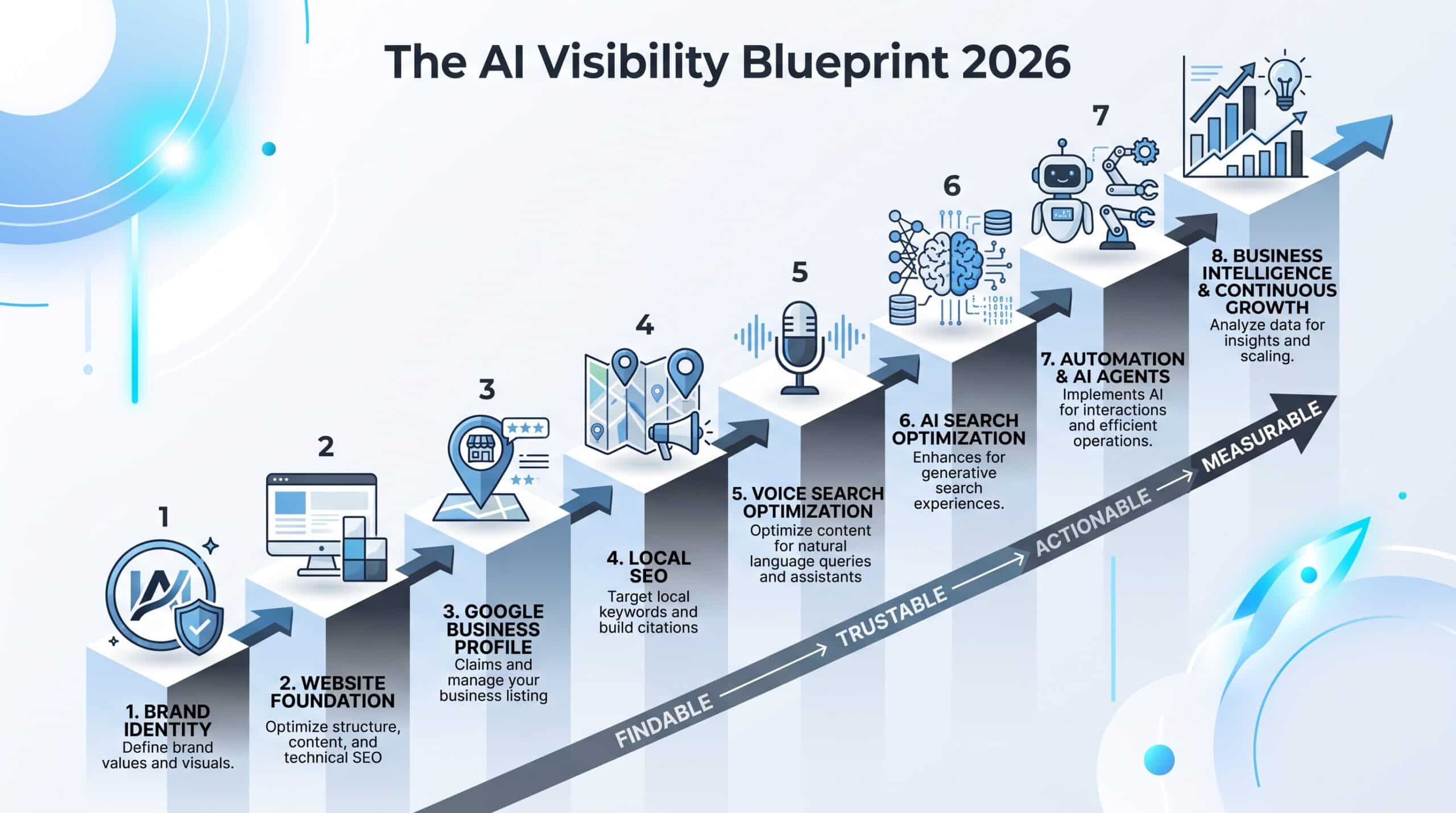
This guide introduces the AI Visibility Blueprint 2026, a practical framework for small and medium-sized businesses that want to strengthen their brand identity, improve local visibility, earn customer trust, and become discoverable across Google Search, Google Maps, AI-powered search engines, voice assistants, and emerging generative platforms.
Drawing on BigBrainWay’s philosophy of helping organizations become findable, trustable, actionable, and measurable, this article outlines how a modern digital foundation, supported by automation, semantic optimization, and measurable analytics, can position businesses for sustainable growth in an AI-first marketplace. This reflects BigBrainWay’s mission to combine creative strategy, AI, automation, and data into practical growth systems for SMBs.
Purpose:
Helping Local Businesses Adapt, Compete, and Grow in 2026
The purpose of this guide is to help local business owners understand what is changing in search and what they can do to stay ahead.
It focuses on practical strategies that help businesses:
- Improve their chances of appearing in traditional search results and AI-generated recommendations.
- Build stronger online trust through helpful content, customer reviews, expertise, and accurate business information.
- Understand how customers are using AI assistants and voice search to make buying decisions.
- Use automation to save time, improve customer communication, and generate more qualified leads.
- Create a sustainable digital presence without chasing every new technology trend.
Whether you run a healthcare practice, restaurant, home service company, retail store, or professional service business, the goal is simple: help more customers find, trust, and choose your business.
Scope: What This Guide Covers
This guide covers the key areas local businesses need to focus on to succeed in the evolving digital landscape of 2026, including:
AI Search Optimization
Understanding how AI-powered search tools discover, evaluate, and recommend businesses – and how to prepare your online presence for these new search experiences.
Local SEO Growth
Improving visibility through Google Business Profile optimization, local keywords, customer reviews, citations, location-based content, and trust signals.
Voice Search Optimization
Creating content that matches how people naturally ask questions through voice assistants and AI tools.
Content, Authority, and Trust Building
Developing useful, experience-based content that demonstrates expertise and helps both customers and AI systems recognize your business as a reliable source.
Smart Automation
Using AI and automation tools to improve marketing workflows, customer engagement, follow-ups, reporting, and daily business operations.
Preparing for the Future of Search
Building a flexible digital strategy that helps businesses remain competitive as search continues to evolve.
Soft Hook
Imagine asking an AI assistant for the “best physiotherapy clinic near me” or “the most trusted contractor in Toronto.”
Now imagine your business never appears in the answer.
Not because your services are poor.
Not because your customers are unhappy.
But because your digital presence was built for yesterday’s search engines instead of today’s AI-powered discovery platforms.
This scenario is becoming increasingly common as customers rely on conversational search, AI-generated recommendations, and voice assistants to make decisions. Businesses that understand this shift early have an opportunity to build lasting visibility while competition is still adapting.
Introduction
For more than two decades, businesses have measured online success by one primary goal: ranking on the first page of Google.
While search engine optimization remains important, the landscape has evolved dramatically. Artificial intelligence now interprets user intent, summarizes trusted sources, and delivers direct answers through AI Overviews, conversational assistants, and voice-enabled devices. Instead of scanning multiple websites, customers increasingly expect immediate, personalized recommendations.
This evolution changes more than search rankings. It changes how businesses earn visibility, establish credibility, and build lasting relationships with customers.
A modern digital strategy must now combine traditional SEO with semantic optimization, structured content, local authority, customer trust, automation, and measurable business intelligence. Organizations that invest in these foundations today will be better positioned to serve customers wherever AI-powered discovery occurs.
Purpose & Scope
This guide is designed for business owners, marketing leaders, and decision-makers who want to future-proof their online presence without chasing every new technology trend.
Its purpose is to provide a practical roadmap that explains:
- Why AI-driven discovery matters for local and service-based businesses.
- How modern SEO extends beyond keywords into semantic understanding and entity authority.
- What role voice search, local optimization, automation, and analytics play in customer acquisition.
- How a phased approach can help businesses strengthen their digital foundation before adopting more advanced AI capabilities.
Rather than focusing on isolated tactics, this blueprint presents an integrated strategy that connects branding, visibility, customer experience, and measurable performance into a sustainable growth model aligned with the evolving expectations of search engines and AI systems. This staged methodology reflects BigBrainWay’s emphasis on creating a solid digital foundation before introducing advanced AI, automation, and analytics capabilities.
The New Era of Search Has Already Begun
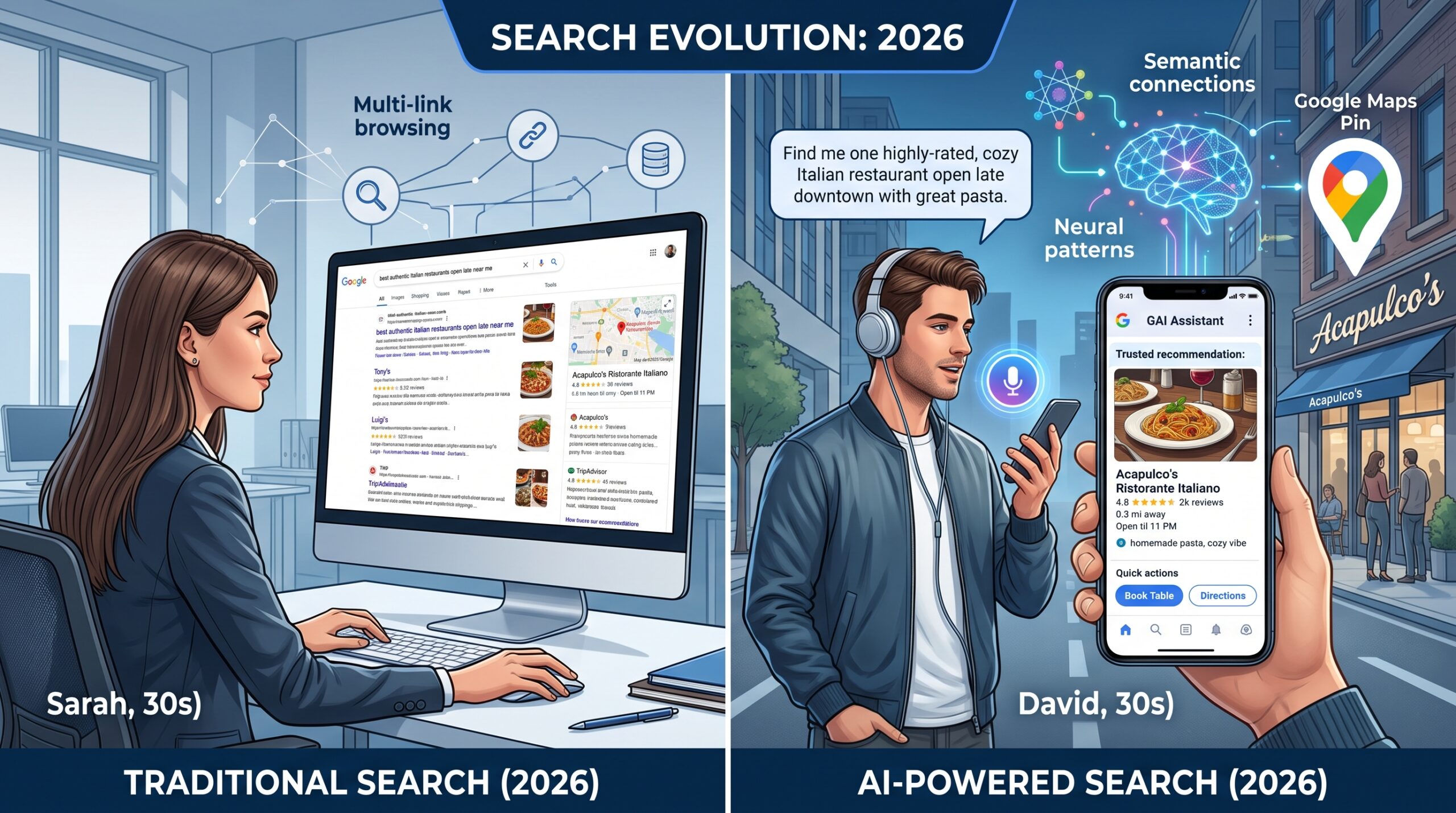
This explains why traditional SEO is evolving, explores AI search behavior in 2026, and introduces the core AI Visibility Blueprint framework.
Search Has Changed Faster Than Most Businesses Realize
For years, businesses invested heavily in ranking higher on search engine results pages. Success often depended on choosing the right keywords, building backlinks, publishing blog content, and improving website performance.
Those fundamentals still matter, but they are no longer the entire picture.
Today’s customers increasingly interact with search in a conversational way. Instead of typing a few keywords, they ask complete questions such as:
- Who is the most trusted physiotherapy clinic near me?
- Which Toronto marketing agency specializes in AI automation for small businesses?
- What’s the best local restaurant that’s open now and has great reviews?
Artificial intelligence analyzes these questions by understanding meaning, context, location, authority, and user intent. Instead of returning a long list of links, AI systems often generate a direct answer supported by businesses they consider trustworthy and relevant.
This shift means that visibility is no longer measured solely by search rankings. Businesses must now earn recognition as reliable entities that AI systems confidently recommend.
Why AI Search Is Reshaping Customer Decisions
Customers no longer follow the same buying journey they did only a few years ago.
A typical customer might:
- Ask ChatGPT for recommendations.
- Verify those recommendations through Google Maps.
- Read recent reviews.
- Visit the business website.
- Check social media activity.
- Book an appointment directly from a mobile device.
Notice something important.
The customer may never perform a traditional Google search.
Instead, artificial intelligence acts as the first filter, helping people narrow their options before they ever visit a website.
For businesses, this creates both a challenge and an opportunity.
Companies with accurate information, strong reputations, structured content, and consistent branding are far more likely to become part of those AI-generated recommendations.
Customer Discovery Has Become Multi-Platform
Today’s customer journey often spans several intelligent platforms before a purchase decision is made.
|
Customer Action |
Platform |
|
Ask a question |
ChatGPT, Gemini, Copilot |
|
Compare options |
Google AI Overviews |
|
Verify reputation |
Google Business Profile |
|
Check reviews |
Google Maps |
|
Visit website |
Business Website |
|
Confirm trust |
Social Media |
|
Book service |
Website or Booking Platform |
Every step contributes to whether your business is selected or overlooked.
From Search Engine Optimization to AI Visibility
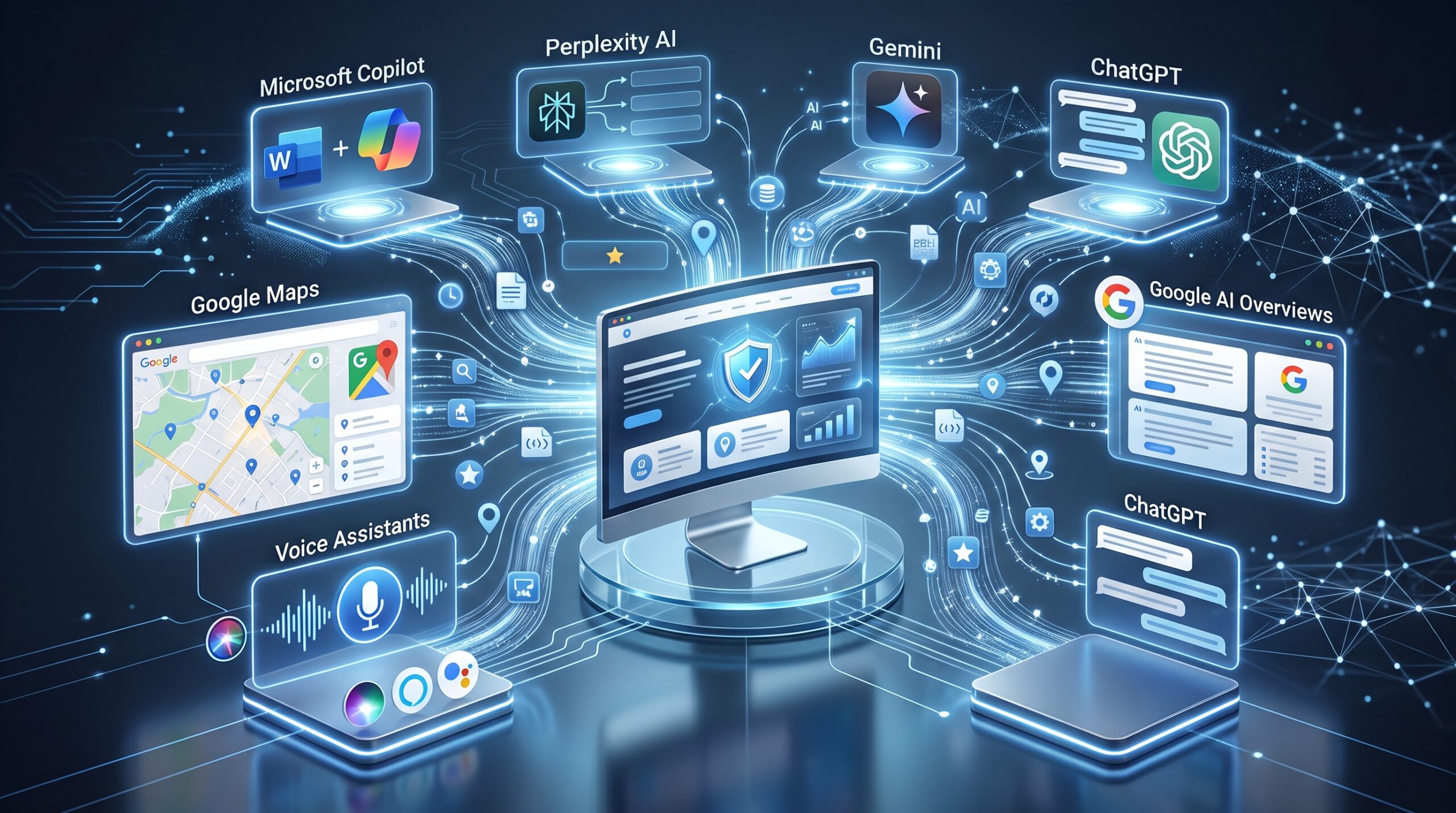
Search Engine Optimization (SEO) is no longer disappearing.
It is expanding.
Modern digital success requires businesses to optimize for several interconnected discovery systems:
Traditional SEO
Helps search engines crawl, index, and rank your website.
Local SEO
Improves visibility on Google Maps and location-based searches.
Voice Search Optimization (VSO)
Ensures your content answers natural-language questions spoken through voice assistants.
Generative Engine Optimization (GEO)
Structures information so AI systems can understand, summarize, and reference your content accurately.
Entity Optimization
Helps AI understand who your business is, what services you provide, where you operate, and why customers trust you.
Experience Signals (E-E-A-T)
Demonstrates real expertise, practical experience, authority, and trustworthiness through authentic content, customer proof, and transparent business information.
These strategies do not replace one another.
Together, they create a resilient digital presence that supports both traditional search engines and emerging AI-powered discovery experiences.
What Does AI Visibility Actually Mean?
AI Visibility refers to the ability of your business to be understood, trusted, and recommended by artificial intelligence systems whenever potential customers ask relevant questions.
Rather than focusing on rankings alone, AI visibility considers whether your business is:
- Easily understood by machines.
- Recognized as a credible source.
- Associated with relevant topics and services.
- Supported by accurate business information.
- Backed by authentic customer reviews.
- Consistently represented across digital channels.
When these signals work together, AI systems gain greater confidence in recommending your business.
Think Beyond Keywords
Traditional SEO often asked:
“Which keyword should we rank for?”
Modern AI asks a different question:
“Which business is most likely to satisfy this customer’s intent?”
That subtle difference changes everything.
Intent, authority, relevance, trust, proximity, reputation, and content quality now work together to influence visibility.
Why Local Businesses Have a Unique Opportunity
One of the biggest misconceptions surrounding artificial intelligence is that it only benefits large national brands.
In reality, local businesses often have an advantage.
Why?
Because AI systems value highly relevant, location-specific, trustworthy information.
A well-maintained local business profile with:
- consistent contact information,
- recent customer reviews,
- high-quality service pages,
- helpful FAQs,
- fresh images,
- accurate business categories, and
- an active online presence,
can outperform much larger competitors for nearby searches.
This aligns with BigBrainWay’s philosophy that businesses should first become findable and trustable before scaling through automation and AI. A strong website, optimized Google Business Profile, consistent branding, and local authority form the essential digital foundation for long-term growth.
The AI Visibility Blueprint™: Building an AI-Ready Business Foundation in 2026
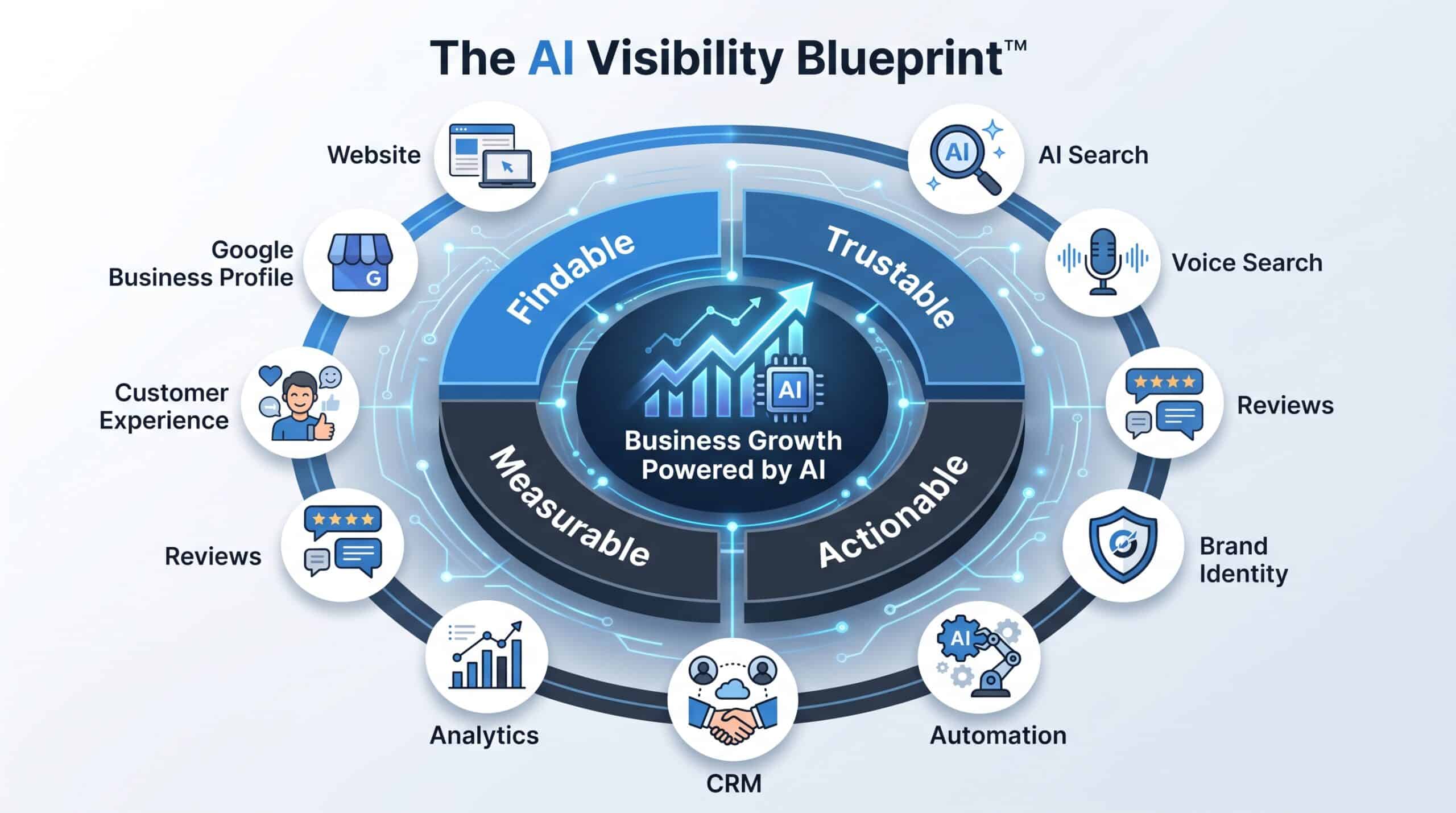
This is introducing BigBrainWay’s proprietary Findable → Trustable → Actionable → Measurable™ framework and detailing the first pillars: Brand Identity, Website Foundation, and Google Business Profile optimization as the essential building blocks for AI-ready business growth.
Why Most Businesses Invest in Marketing Too Late
One of the most common challenges facing small and medium-sized businesses is not a lack of effort. It is investing in advanced marketing before the fundamentals are in place.
Many organizations spend heavily on advertising, social media campaigns, or AI tools while overlooking the essentials that influence whether customers and AI systems trust their business in the first place.
Without a consistent digital foundation, every marketing investment becomes less effective.
At BigBrainWay, we approach growth differently. Rather than chasing isolated tactics, we help businesses strengthen the building blocks that support sustainable visibility, customer confidence, and measurable performance. Our methodology emphasizes creating a reliable digital foundation before layering on advanced AI, automation, and analytics, enabling businesses to become findable, trustable, actionable, and measurable over time.
The Four Pillars of AI Visibility™
The AI Visibility Blueprint™ is built around four interconnected pillars. Together, they create a digital ecosystem that supports both traditional search engines and modern AI-powered discovery platforms.
Pillar 1- Findable
Can customers and AI systems find your business?
Visibility today depends on far more than appearing in search results.
Modern discoverability includes:
- A fast, mobile-friendly website
- Optimized Google Business Profile
- Consistent Name, Address, and Phone (NAP) information
- Clear service pages
- Structured data (Schema)
- AI-readable content
- Voice search optimization
- Location relevance
- Semantic internal linking
If your digital presence sends conflicting signals, AI systems may struggle to understand your business accurately.
Practical Example
A dental clinic with an outdated website, inconsistent business hours across platforms, and limited service descriptions is less likely to be recommended than a competitor with accurate information, structured content, and active local engagement.
Pillar 2 – Trustable
Artificial intelligence increasingly evaluates signals that reflect credibility and expertise. These include:
- Authentic customer reviews
- Professional branding
- Consistent messaging
- Accurate business information
- Demonstrated expertise through helpful content
- Clear contact details
- Secure website (HTTPS)
- Transparent policies
- Up-to-date business profiles
Every interaction contributes to whether a potential customer feels confident choosing your business.
Trust Is Built Across Every Touchpoint
Customers often compare several businesses before making a decision. They may visit your website, review your Google Business Profile, browse your social media, and read recent customer feedback.
Consistency across these channels creates confidence.
Pillar 3 – Actionable
Ask yourself:
- Can visitors book online?
- Is your phone number clickable?
- Are contact forms simple to complete?
- Does your website clearly explain your services?
- Is there an obvious call to action on every important page?
Reducing friction helps convert interest into action.
Every Click Should Have a Purpose
An AI assistant may recommend your business, but the customer experience that follows determines whether an inquiry becomes a booking.
Simple improvements such as streamlined navigation, online scheduling, and responsive mobile design can significantly improve conversion rates.
Pillar 4 – Measurable
Businesses should monitor:
- Website traffic
- Search visibility
- Google Business Profile interactions
- Phone calls
- Booking requests
- Customer reviews
- Conversion rates
- Campaign performance
- Customer acquisition sources
Without measurement, marketing becomes guesswork.
Modern analytics provide the insights needed to refine strategies and invest in what works.
Building the Right Foundation Before Advanced AI
Artificial intelligence delivers the greatest value when it enhances an already healthy digital ecosystem.
Introducing AI into a business with outdated information, inconsistent branding, or broken customer journeys often amplifies existing weaknesses.
A phased approach ensures each layer supports the next.
Phase 1- Establish Digital Credibility
Focus on:
- Professional website
- Brand consistency
- Google Business Profile optimization
- Accurate business information
- Local SEO
- Customer reviews
Phase 2 – Strengthen Visibility
Expand through:
- Helpful educational content
- Frequently asked questions
- Semantic internal linking
- Service-specific pages
- Structured data
- Voice-search-friendly content
Phase 3 – Introduce Automation
Enhance operations with:
- AI chat assistants
- Automated review requests
- Appointment reminders
- CRM workflows
- Email automation
- Lead nurturing
Phase 4 – Optimize with Intelligence
Leverage:
- Business dashboards
- Predictive insights
- Customer behavior analysis
- AI-supported decision making
- Continuous optimization
This staged progression reflects BigBrainWay’s service philosophy: begin with Tier 1 essentials such as websites, Google Business Profiles, and brand consistency, then advance toward CRM integration, automation, AI agents, and business intelligence as the digital foundation matures.
Common Foundation Mistakes That Limit AI Visibility
Many businesses unknowingly reduce their visibility by overlooking foundational issues.
Common examples include:
- Inconsistent business information across platforms
- Outdated website content
- Slow page loading speeds
- Missing service descriptions
- Incomplete Google Business Profiles
- Limited customer reviews
- Broken booking links
- Generic content with little local relevance
- Lack of structured FAQs
- Infrequent updates to business information
Addressing these issues often produces measurable improvements before more advanced optimization is required.
Optimizing for AI Search, Voice Search, and Google's AI Overviews
This section will explain how semantic SEO, structured data, conversational content, Google Business Profile optimization, and entity authority work together to help businesses become trusted recommendations across AI-powered search platforms
How to Optimize for AI Search, Voice Search & Google's AI Overviews in 2026
Search Engines Index Pages. AI Understands Meaning
Traditional search engines primarily relied on keywords, backlinks, and page authority to determine rankings.
Today’s AI-powered search systems go much further.
Instead of asking:
“Does this page contain the keyword?”
AI asks:
- Does this business answer the customer’s question?
- Is the information trustworthy?
- Is it current?
- Is it supported by multiple credible signals?
- Would users benefit from this recommendation?
This evolution represents one of the biggest shifts in digital marketing since the introduction of search engines themselves.
Businesses that organize their information clearly, demonstrate expertise, and maintain consistent digital profiles are more likely to be surfaced in AI-generated responses.
Understanding Semantic SEO
Semantic SEO focuses on helping machines understand relationships between topics rather than simply matching keywords.
Instead of creating one page for every keyword variation, businesses should develop comprehensive content that answers related customer questions naturally.
For example, a page about Google Business Profile Optimization could also address:
- Local SEO best practices
- Google Maps visibility
- Customer reviews
- Business categories
- Local citations
- Opening hours
- Service areas
- Frequently asked questions
- Voice search queries
This interconnected approach helps search engines and AI systems build a deeper understanding of your expertise.
Why Structured Data Matters More Than Ever
Structured data, often implemented using Schema.org markup, provides explicit information about your business.
It helps AI systems identify:
- Business name
- Location
- Services
- Opening hours
- Reviews
- Contact details
- Frequently asked questions
- Events
- Products
- Articles
- Authors
Well-implemented structured data increases the likelihood that your information is interpreted correctly across search engines and AI-powered experiences.
Recommended Schema Types
For local businesses, consider implementing:
- Organization
- LocalBusiness
- Service
- FAQPage
- Article
- BreadcrumbList
- Review
- Person (Author)
- ImageObject
- VideoObject
Each schema type contributes additional context that strengthens your digital identity.
Voice Search Optimization (VSO)
Voice search continues to grow as consumers rely on smartphones, smart speakers, in-car assistants, and wearable devices.
Unlike typed searches, spoken queries are more conversational.
Instead of typing:
Toronto physiotherapy
Customers often ask:
Who is the best physiotherapist near me that’s open today?
Or:
Can you recommend a trusted marketing agency in Toronto that helps small businesses use AI?
To capture these opportunities:
Write Naturally
Use conversational language that mirrors how people speak.
Answer Questions Directly
Provide concise, helpful responses near the beginning of each section.
Include Local Context
Reference neighborhoods, cities, and service areas where appropriate.
Use FAQ Sections
Well-structured FAQs improve accessibility for both users and AI systems.
Optimize Mobile Performance
Many voice searches originate from mobile devices, making speed and usability essential.
Entity SEO: Helping AI Understand Who You Are
Entity SEO goes beyond keywords by defining your business as a recognizable organization with clear relationships.
Strong entity signals include:
- Consistent business name
- Verified Google Business Profile
- Accurate website information
- Professional author biographies
- High-quality citations
- Customer reviews
- Social media consistency
- Industry associations
- Local community involvement
- Clear service descriptions
When these signals align, AI systems gain greater confidence in recommending your business.
Consistency Builds Confidence
Imagine your website lists one phone number while your Google Business Profile displays another.
Even small inconsistencies can reduce confidence.
Maintaining accurate and synchronized business information across all digital platforms strengthens trust for both customers and AI systems.
BigBrainWay emphasizes this same principle in its local visibility framework, where consistent business information, optimized Google Business Profiles, and disciplined digital asset management support stronger local search performance and AI understanding.
Content That AI Wants to Reference
AI-generated responses favor content that is:
- Accurate
- Well-structured
- Easy to understand
- Comprehensive
- Up to date
- Supported by credible sources
- Helpful rather than promotional
The following formats often perform well:
- How-to guides
- Step-by-step tutorials
- Frequently asked questions
- Checklists
- Industry insights
- Comparison articles
- Case studies
- Original research
- Local business guides
Publishing content that genuinely solves customer problems increases the likelihood of being referenced in AI-generated summaries.
Google Business Profile Remains a Cornerstone
Even as AI search evolves, the Google Business Profile remains one of the strongest local trust signals.
Maintain your profile by:
- Updating business hours promptly.
- Selecting accurate primary and secondary categories.
- Adding high-quality photos regularly.
- Responding to every customer review professionally.
- Publishing Google Posts consistently.
- Completing all available profile fields.
- Monitoring questions and answers.
- Verifying contact information.
These activities improve customer confidence while strengthening local visibility.
AI Automation, Customer Experience, CRM, and Business Intelligence
This is showing how businesses can transform visibility into measurable growth using intelligent workflows, AI assistants, review automation, lead nurturing, analytics, and continuous optimization. It will connect digital marketing with operational efficiency to complete the AI Visibility Blueprint.
From Visibility to Growth: How AI Automation, CRM & Business Intelligence Turn More Visitors into Customers in 2026
The Biggest Opportunity Isn’t More Traffic. It’s Better Systems
Many business owners believe they need more website visitors to grow.
Sometimes they do.
More often, they need a better system for converting the visitors they already have.
Consider this scenario:
A potential customer discovers your business through an AI-generated recommendation. They visit your website, browse your services, and decide to contact you. If their inquiry sits unanswered for hours or even days, the opportunity may be lost to a competitor who responds first.
Technology cannot replace genuine human relationships, but it can ensure that every inquiry is acknowledged promptly, routed efficiently, and followed up consistently.
This is where automation transforms visibility into measurable business growth.
AI Automation Enhances Customer Experience
Artificial intelligence is most effective when it supports routine tasks, allowing people to focus on meaningful conversations and strategic decisions.
Examples of customer-focused automation include:
Intelligent Website Chat Assistants
Provide immediate answers to common questions.
Help visitors locate services.
Collect inquiry information.
Schedule appointments.
Route urgent requests.
Automated Appointment Confirmations
Reduce missed appointments.
Improve customer confidence.
Keep schedules organized.
Review Request Workflows
Encourage satisfied customers to share feedback.
Strengthen online reputation.
Increase local trust signals.
Follow-Up Email Sequences
Deliver helpful resources.
Answer common questions.
Maintain engagement until customers are ready to make a decision.
CRM Notifications
Alert teams when:
- A new lead arrives.
- A proposal remains unanswered.
- A follow-up is overdue.
- A customer books an appointment.
Automation improves consistency while ensuring no opportunity is overlooked.
Why Every Growing Business Needs a CRM
A Customer Relationship Management (CRM) platform is more than a contact database.
It becomes the central source of truth for customer interactions.
A well-configured CRM helps businesses:
- Track inquiries.
- Record customer conversations.
- Monitor follow-up activities.
- Organize appointments.
- Segment customers.
- Measure sales performance.
- Coordinate team communication.
Without a CRM, valuable information often becomes scattered across emails, spreadsheets, notebooks, and messaging applications.
AI Makes CRM Even More Valuable
Modern AI can assist by:
- Summarizing customer conversations.
- Recommending follow-up actions.
- Prioritizing leads.
- Drafting personalized responses.
- Predicting customer needs.
- Identifying sales trends.
The result is a more organized, responsive, and customer-focused business.
Business Intelligence Turns Data Into Decisions
Collecting data is important.
Understanding it is essential.
Business Intelligence (BI) dashboards transform information into practical insights.
Examples include:
- Website traffic trends.
- Lead sources.
- Conversion rates.
- Appointment bookings.
- Customer retention.
- Review growth.
- Revenue by service.
- Marketing campaign performance.
Instead of relying on assumptions, businesses can make informed decisions based on measurable outcomes.
Questions Every Dashboard Should Answer
- Which services generate the most inquiries?
- Which locations perform best?
- Which marketing channels produce qualified leads?
- How quickly are inquiries answered?
- Where are customers dropping out?
- Which campaigns produce the highest return?
These insights guide continuous improvement.
AI Agents Support, Not Replace, Your Team
One of the most common misconceptions about artificial intelligence is that it replaces people.
In reality, the greatest value comes from collaboration.
AI handles repetitive, predictable tasks.
People provide empathy, creativity, and strategic thinking.
Examples include:
|
AI Supports |
People Lead |
|
FAQ responses |
Consultations |
|
Appointment scheduling |
Relationship building |
|
Lead qualification |
Complex sales conversations |
|
Reminder messages |
Personalized recommendations |
|
Reporting |
Strategic planning |
|
Workflow automation |
Business leadership |
This balance improves efficiency while preserving authentic customer relationships.
BigBrainWay’s AI approach follows this philosophy by using automation and AI agents to handle repetitive activities such as scheduling, follow-ups, review requests, and lead management, while keeping high-value customer interactions and strategic decisions in human hands.
The Power of Connected Business Systems
Businesses often use many excellent tools.
The challenge is that those tools rarely communicate effectively.
Imagine this connected workflow:
- A customer discovers your business through Google AI Search.
- They visit your website.
- An AI assistant answers initial questions.
- The customer books an appointment online.
- Their information is automatically added to your CRM.
- A confirmation email is sent instantly.
- Your team receives a notification.
- A reminder is delivered before the appointment.
- After the service, a review request is automatically sent.
- Performance data updates your business dashboard.
Instead of managing separate systems manually, automation creates a seamless customer experience from discovery to long-term loyalty.
Local Businesses Can Benefit More Than Large Enterprises
Large organizations often struggle with complex processes and slow decision-making.
Small businesses can adapt more quickly.
By implementing practical AI solutions, local organizations can:
- Respond faster.
- Personalize customer experiences.
- Improve operational efficiency.
- Strengthen online reputation.
- Reduce administrative work.
- Scale without significantly increasing overhead.
Agility becomes a competitive advantage.
Measuring Success Beyond Rankings
High search visibility is valuable.
Business growth requires broader measurement.
Consider tracking:
Visibility Metrics
- Organic traffic.
- Google Business Profile views.
- AI referral traffic.
- Voice search impressions.
Engagement Metrics
- Time on page.
- Form submissions.
- Phone calls.
- Appointment requests.
Reputation Metrics
- Review quantity.
- Review quality.
- Response time.
- Customer satisfaction.
Operational Metrics
- Lead response time.
- CRM utilization.
- Automation success rates.
- Follow-up completion.
Revenue Metrics
- Customer acquisition cost.
- Conversion rate.
- Customer lifetime value.
- Repeat business.
Tracking these indicators provides a complete picture of business performance.
A Continuous Improvement Mindset
AI search, customer expectations, and digital platforms will continue to evolve.
The businesses that succeed will not be those that implement one perfect strategy.
They will be the organizations that continually measure, learn, adapt, and improve.
Small, consistent improvements accumulate over time.
Updating service pages.
Refreshing business information.
Publishing helpful articles.
Responding to customer reviews.
Refining automation workflows.
Monitoring performance.
Each action strengthens your digital presence and increases long-term resilience.
Your 2026 AI Visibility Action Plan: Avoid Common Mistakes, Build Authority, and Future-Proof Your Business
The Businesses That Will Lead in 2026 Are Preparing Today
The AI Visibility Action Plan for 2026
The transition to AI-powered discovery does not require businesses to reinvent everything overnight.
Instead, it calls for a structured, practical approach that strengthens the fundamentals while preparing for future innovation.
The following roadmap provides a realistic sequence for businesses of all sizes.
Phase 1: Build a Strong Digital Foundation
Before investing in advanced AI technologies, ensure your core digital assets are healthy.
Priority Actions
✔ Modern, mobile-friendly website
✔ Consistent brand identity
✔ Optimized Google Business Profile
✔ Accurate business information
✔ Secure HTTPS website
✔ Fast page speed
✔ Clear service pages
✔ Professional photography
✔ Online booking or contact forms
✔ Basic analytics installed
Phase 2 – Establish Trust and Authority
Once customers can find your business, the next goal is becoming the business they trust.
Focus on building credibility through:
- Helpful educational content
- Customer testimonials
- High-quality reviews
- Transparent business information
- Frequently updated service pages
- Staff expertise
- Community involvement
- Industry certifications
Trust compounds over time.
Every helpful interaction contributes to your long-term digital reputation.
Phase 3 – Become AI Search Ready
This stage prepares your business for Google AI Overviews, ChatGPT, Gemini, Perplexity, Microsoft Copilot, and future AI-powered search platforms.
Key priorities include:
- Semantic content organization
- Structured data implementation
- Topic clusters
- Internal linking
- Conversational FAQs
- Voice-search-friendly content
- Entity optimization
- Consistent citations
- Local relevance
- Fresh business information
These improvements help AI systems understand your business more accurately.
Phase 4 – Connect Your Customer Journey
Every customer interaction should feel seamless.
A connected digital ecosystem may include:
Website
↓
AI Chat Assistant
↓
CRM
↓
Appointment Booking
↓
Email Automation
↓
Customer Follow-up
↓
Review Request
↓
Business Dashboard
Rather than managing disconnected tools, businesses benefit from an integrated workflow that improves customer experience while reducing manual effort.
Phase 5 – Measure, Improve, Repeat
Digital growth is an ongoing process.
Successful businesses regularly review:
- Website performance
- Search visibility
- AI referral traffic
- Customer inquiries
- Review trends
- Conversion rates
- Marketing ROI
- Customer retention
Continuous improvement helps businesses adapt as technology and customer expectations evolve.
Seven Common Mistakes Businesses Still Make
Even with access to advanced technology, many organizations continue to repeat the same foundational mistakes.
Mistake 1: Treating SEO as a One-Time Project
Search optimization requires ongoing maintenance.
Content, reviews, business information, and customer expectations evolve continuously.
Mistake 2: Ignoring Google Business Profile
An incomplete or outdated profile reduces local visibility and customer confidence.
Maintaining accurate business information remains one of the highest-impact activities for local businesses. BigBrainWay’s guidance emphasizes keeping Google Business Profiles complete, current, and consistently managed because they are foundational to local visibility and AI understanding.
Mistake 3: Publishing Content Without Purpose
Every article should answer a genuine customer question.
Helpful content performs better than promotional content.
Mistake 4: Inconsistent Branding
Customers should recognize the same business whether they visit:
- Your website
- Google Business Profile
- Social media
- Email communications
Consistency strengthens recognition and trust.
Mistake 5: Delayed Customer Responses
Today’s customers expect timely communication.
Automation helps businesses respond promptly while maintaining a personal experience.
Mistake 6: Measuring Vanity Metrics
Traffic alone does not guarantee success.
Meaningful metrics include:
- Qualified leads
- Bookings
- Revenue
- Customer retention
- Lifetime value
- Satisfaction
Mistake 7: Waiting Too Long to Prepare for AI
Artificial intelligence is already influencing how customers discover businesses.
Preparing now provides a competitive advantage while adoption is still accelerating.
Industry Examples
Healthcare Clinics
Patients increasingly search for trusted providers using conversational questions.
Helpful educational content, verified reviews, and accurate Google Business Profiles strengthen credibility.
Home Services
Customers often prioritize businesses with strong local visibility, recent reviews, and clear service information.
Fast response times remain critical.
Restaurants and Cafés
Fresh menus, updated hours, quality photography, and active customer engagement improve discoverability.
Professional Services
Law firms, accountants, consultants, and financial professionals benefit from demonstrating expertise through educational resources and authoritative content.
Retail Businesses
AI-driven recommendations increasingly consider product information, customer reviews, local inventory, and business reputation.
What Makes Businesses AI-Ready?
An AI-ready business is not defined by how many AI tools it uses.
Instead, it demonstrates:
✔ Clear digital identity
✔ Accurate business information
✔ Helpful content
✔ Strong customer relationships
✔ Consistent branding
✔ Reliable operational systems
✔ Data-driven decision-making
✔ Continuous learning
Technology becomes significantly more valuable when built upon these fundamentals.
Expert Perspective
Businesses that consistently educate, serve, and support their customers build digital authority that extends beyond search rankings. As AI continues to evolve, authority and trust will become even more valuable than visibility alone.
2026 AI Visibility Checklist
Use this checklist as a practical self-assessment.
Visibility
✔ Website optimized
✔ Google Business Profile complete
✔ Local citations consistent
✔ Mobile-friendly design
✔ Voice search optimization
Authority
✔ Helpful blog content
✔ Customer testimonials
✔ Expert service pages
✔ Recent reviews
✔ Active social presence
Customer Experience
✔ Online booking
✔ Fast response time
✔ AI chat assistant
✔ CRM integration
✔ Automated follow-up
Analytics
✔ GA4 configured
✔ Search Console connected
✔ Conversion tracking
✔ CRM reporting
✔ Business dashboard
AI Readiness
✔ Structured data
✔ Semantic content
✔ Topic clusters
✔ Internal linking
✔ Entity optimization
Conclusion: The Future Belongs to Businesses That Build Trust Before Technology
Artificial intelligence is changing how people search, compare, and choose businesses, but one principle remains constant: customers prefer organizations they trust.
While AI-powered search engines, voice assistants, and generative platforms continue to evolve, they all rely on the same foundational signals: accurate information, helpful content, consistent branding, positive customer experiences, and demonstrated expertise.
Businesses that invest in these fundamentals today are preparing for more than better rankings. They are building long-term resilience in a marketplace where trust, relevance, and usability increasingly determine visibility.
The AI Visibility Blueprint™ provides a practical framework for achieving this goal by helping organizations become:
- Findable through modern SEO, local optimization, and AI-ready content.
- Trustable through authentic expertise, consistent branding, and customer credibility.
- Actionable through intuitive user experiences, clear calls to action, and connected customer journeys.
- Measurable through analytics, business intelligence, and continuous improvement.
This structured approach aligns with BigBrainWay’s mission to help small and medium-sized businesses adopt enterprise-inspired digital strategies, AI, and automation in a practical and sustainable way.
Key Takeaways
AI search is becoming a major way customers discover local businesses, making visibility across multiple platforms more important than traditional rankings alone.
- Strong local SEO still forms the foundation of online success, especially through an optimized website, Google Business Profile, customer reviews, and location-focused content.
- Helpful, experience-based content is more likely to be recommended by both search engines and AI assistants than content created only to target keywords.
- Business information should remain accurate and consistent across your website, Google Business Profile, social media, and online directories.
- Automation can improve customer response times, simplify lead management, encourage more reviews, and reduce repetitive administrative work.
- The businesses that embrace AI strategically while continuing to provide excellent customer service will have a lasting competitive advantage.
Final Executive Recap
If you remember only five ideas from this guide, make them these:
- SEO remains essential, but AI Visibility is the next evolution.
- Helpful, trustworthy content outperforms promotional content over time.
- Google Business Profile, structured data, and local authority remain critical.
- Automation should improve customer experiences, not replace human relationships.
- Businesses that measure, learn, and improve consistently will be best positioned for long-term growth.
Frequently Asked Questions
- What is AI Visibility?
AI Visibility is the ability of a business to be discovered, understood, and recommended by AI-powered search engines and conversational assistants through trusted, structured, and relevant digital information.
- Is traditional SEO still important in 2026?
Yes. Traditional SEO remains the foundation, but it should now be complemented by semantic SEO, Voice Search Optimization (VSO), Generative Engine Optimization (GEO), and strong E-E-A-T signals.
- Can ChatGPT recommend my business?
AI assistants may reference or recommend businesses when they have sufficient public, trustworthy, and relevant information. Maintaining a strong website, accurate business profiles, and authoritative content increases your likelihood of being surfaced.
- What is Generative Engine Optimization (GEO)?
GEO focuses on structuring content so generative AI systems can understand, summarize, and reference it accurately in conversational responses.
- How does Voice Search Optimization help local businesses?
Voice search favors natural language, concise answers, and location-specific information. Optimizing for conversational queries improves visibility when customers use voice assistants.
- Why are Google Business Profiles still important?
They remain one of the strongest local trust and discovery signals, influencing Google Search, Google Maps, and AI-assisted local recommendations.
- What role does E-E-A-T play in AI search?
Experience, Expertise, Authoritativeness, and Trustworthiness help search engines and AI systems evaluate the credibility of your content and business.
- How often should I update my website?
Review your core business information quarterly and update service pages, blog articles, images, and FAQs regularly to keep content accurate and relevant.
- What is Entity SEO?
Entity SEO helps search engines understand who your business is, what it offers, where it operates, and how it relates to other trusted entities.
- Is AI replacing human marketers?
No. AI enhances productivity, automation, and analysis, while human creativity, strategic thinking, and relationship-building remain essential.
- How can small businesses compete with larger brands?
By focusing on local expertise, consistent branding, helpful content, customer reviews, and a seamless customer experience, smaller organizations can become highly relevant for specific audiences.
- How long does it take to improve AI visibility?
Results vary by industry and competition, but businesses that consistently improve their digital foundations often see measurable progress over several months.
About BigBrainWay
BigBrainWay (BBW) helps small and medium-sized businesses strengthen their brand identity, improve online visibility, optimize local search performance, implement AI-driven automation, and make data-informed decisions.
Based in Toronto, Ontario, BBW combines modern web technologies, local SEO, AI strategy, workflow automation, CRM integration, and business intelligence to help organizations grow with confidence.
Office:
Toronto, ON M1K 3B8, Canada
Ready to Future-Proof Your Business?
Every day, customers ask AI assistants where to shop, who to trust, and which businesses deserve their attention.
Will your business be part of the answer?
Whether you are improving your website, strengthening your local presence, implementing automation, or preparing for AI-powered search, building the right foundation today positions your business for sustainable growth tomorrow.
Call to Action
Let’s Build Your AI Visibility Strategy
Partner with BigBrainWay to create a stronger digital foundation through:
- AI Visibility Strategy
- Brand Identity Development
- Website Design & Optimization
- Local SEO & Google Business Profile Optimization
- AI Automation & Workflow Integration
- CRM Implementation
- Business Intelligence Dashboards
- AI Readiness Consulting
Book a discovery meeting to discuss how your business can improve its online visibility, strengthen customer trust, and prepare for the future of AI-powered search.
Suggested Booking CTA:
https://bigbrainway.com/contact
Internal Links
- AI Consulting
https://bigbrainway.com/careers/
- Website Design
https://bigbrainway.com/web-pages-funnels/
https://bigbrainway.com/map-authority/
- Local SEO
https://bigbrainway.com/article/ai-automation-local-seo-growth-2026/
https://bigbrainway.com/vector-search-optimization/
Google Business Profile Optimization
- https://bigbrainway.com/optimize-google-business-profile-gbp/
- CRM Solutions
- Workflow Automation
https://bigbrainway.com/article/ai-automation-local-seo-growth-2026/
- Business Intelligence
https://bigbrainway.com/optimize-google-business-profile-gbp/
- AI Strategy
https://bigbrainway.com/ai-automation/
- Contact Us
https://bigbrainway.com/contact/
- About BigBrainWay
https://bigbrainway.com/about-big-brain-way/
- Blog
https://bigbrainway.com/bbw-blog/
- Case Studies
- https://bigbrainway.com/?s=Case+Studies
External Resources
- Google Search Central documentation
https://developers.google.com/search/docs
- Google Business Profile Help
https://support.google.com/business/?hl=en#topic=4596754
- W3C Web Accessibility Initiative (WAI)
- NIST AI Risk Management Framework
https://www.nist.gov/itl/ai-risk-management-framework
- OpenAI developer guidance
https://developers.openai.com/
- Microsoft Learn AI documentation
https://learn.microsoft.com/en-us/ai/?tabs=business-technical-leader
References
- Google Search Central
https://developers.google.com/search
- Google Business Profile documentation
https://support.google.com/business/answer/3038177?hl=en
- W3C
- NIST
- Academic and peer-reviewed research on search, AI, usability, and digital marketing
- Industry benchmarking reports published in 2025-2026
https://www.skillcast.com/resources/2026-annual-benchmarking-report
0 Comments