
Vector Search Optimization (VSO) is how you make your business “understandable” to AI like ChatGPT, Google Gemini, and Claude. Instead of just matching keywords, VSO ensures your content’s meaning matches the user’s intent, making you the top choice when AI answers a question.
At BigBrainWay, we don’t “hope” for rankings; we engineer Semantic Density. Traditional SEO is a linear keyword match. VSO is a high-dimensional math problem. AI models convert your text into “Vectors” (numerical coordinates in a multi-dimensional space).
To win, your content must achieve high Cosine Similarity to the user’s query vector. If your “Experience” and “Trust” signals (E-E-A-T) are mathematically distant from the “Expertise” vector, you are invisible to AI.
We use RankMath not just for green lights, but to anchor your data via Schema.org, ensuring LLMs (Large Language Models) don’t hallucinate your brand’s facts.
Vector Search Optimization
In 2026, the digital landscape has undergone a seismic shift. Traditional “blue link” search is no longer the primary gateway for customers; instead, 60% of users now engage with AI-generated summaries before ever clicking a website link. To stay relevant, small and medium businesses (SMBs) must move beyond simple keywords and embrace Vector Search Optimization (VSO), the process of engineering content so AI models like Gemini and ChatGPT can mathematically “understand” and recommend your brand.
The 2026 Search Reality: From Clicks to Citations
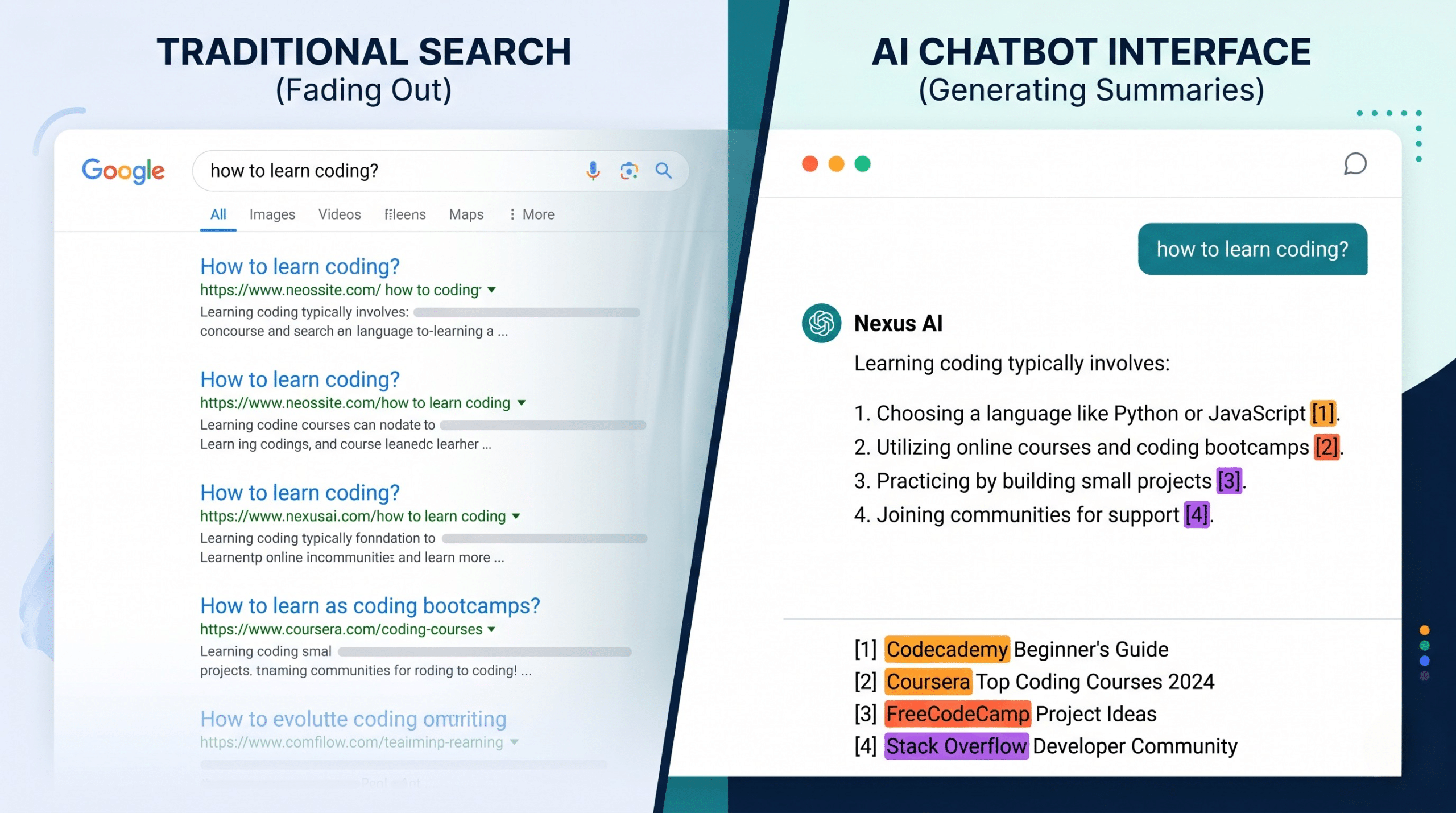
According to Gartner, traditional search engine volume is projected to drop by 25% by the end of 2026 as AI chatbots become the preferred “answer engines.” For a business, this means that “ranking #1” is less important than being the cited source within an AI’s conversational response. If your data isn’t structured for vector search, your business effectively becomes invisible to the LLMs (Large Language Models) that now mediate half of all consumer discovery.
What is Vector Search Optimization (VSO)?

Vector Search Optimization is a strategic approach that organizes content into “embeddings” numerical coordinates in a multi-dimensional space. Unlike traditional SEO, which looks for exact word matches, VSO focuses on semantic similarity. This allows AI to connect a user’s intent (e.g., “cozy workspace with fast internet”) to your business even if those exact words aren’t on your page, provided your content maps to those concepts. The Vector Index Optimization market is expected to reach $2.16 billion in 2026, reflecting how critical this “machine-readability” has become for SMB growth.
The 4 Pillars of the AI Search Stack
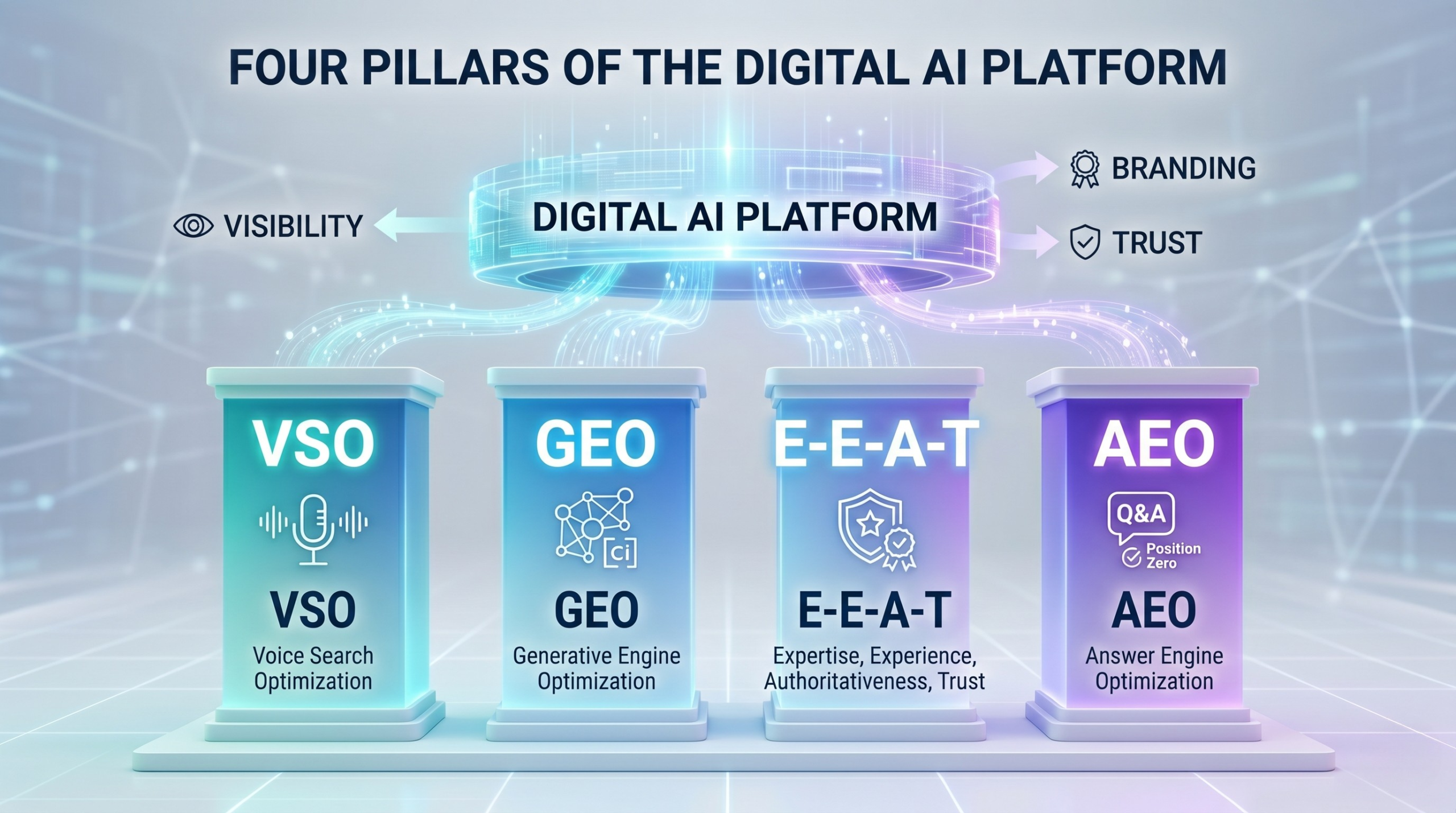
- VSO & Semantic SEO: Using structured data and RankMath Schema to define your business as a distinct “Entity” that AI can verify.
- Generative Engine Optimization (GEO): Optimizing content specifically to be featured in AI Overviews and summaries.
- E-E-A-T (The Trust Math): Proving Experience, Expertise, Authoritativeness, and Trustworthiness through verified citations and author bios.
- AEO (Answer Engine Optimization): Structuring content as direct Q&A blocks to capture voice search and chatbot queries.
E-E-A-T: Why AI Values the "Human Touch"
AI-generated content floods the web, search engines have pivoted to reward Information Gain unique, first-hand insights that AI cannot simply replicate. In 2026, Trustworthiness is the most critical element of E-E-A-T. Businesses must use Person and Organization Schema to link their websites to real-world credentials, social proof, and verified reviews to signal to AI that their information is safe to recommend.
Best Practices for VSO Implementation
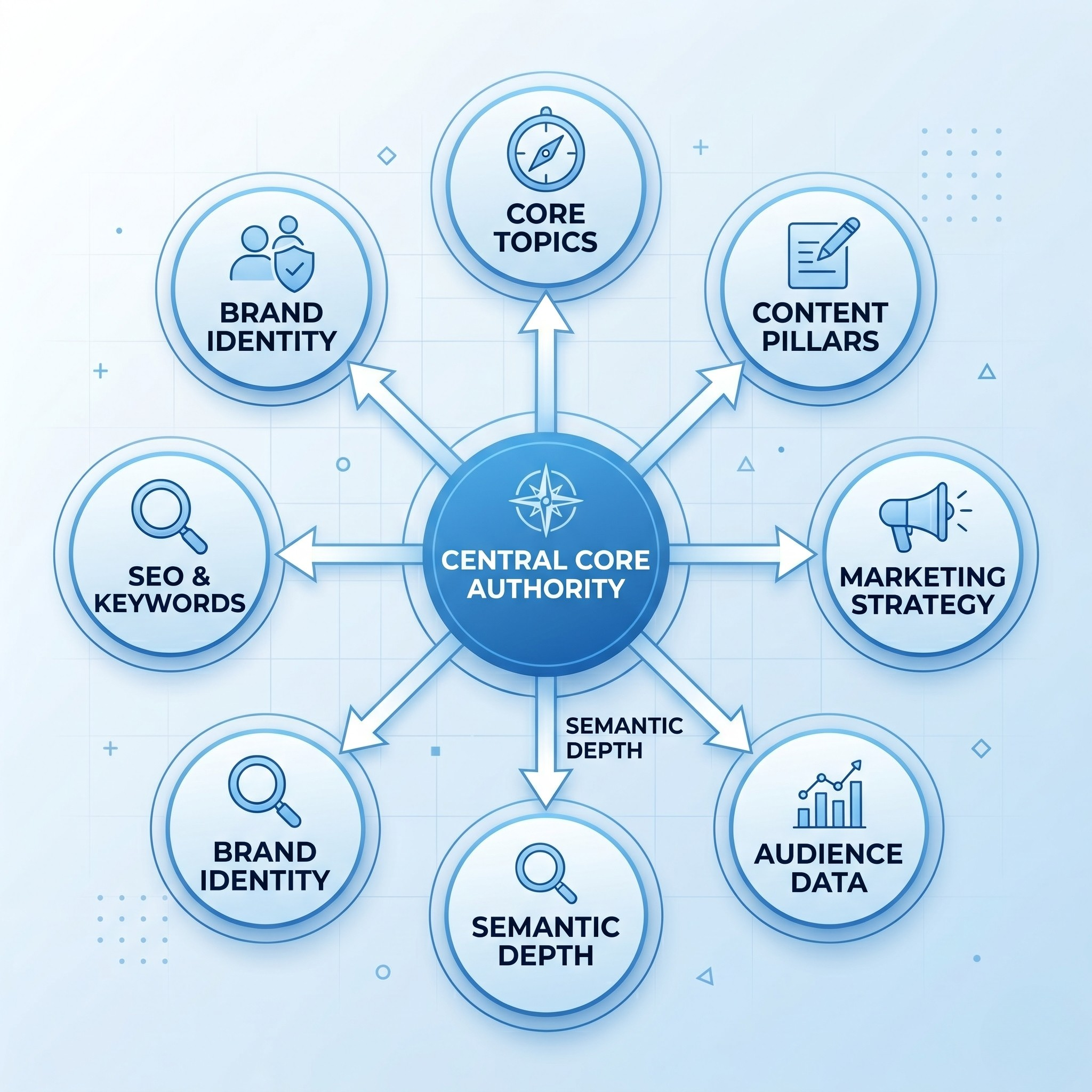
- Adopt Topic Clusters: Stop writing isolated blogs. Create deep “pillar pages” that cover a subject comprehensively, signaling to AI that you are a topical authority.
- Schema is Your Secret Weapon: Use RankMath to inject advanced Schema markup. This acts as a “map” for LLMs to find your prices, locations, and services without error.
- Optimize for Natural Language: 50% of consumers have now made purchases via voice assistants. Write like you speak; use conversational headings that mirror real user questions.
- Focus on Information Density: AI rewards “fact-dense” content. Replace fluff with statistics, case studies, and original data.
Why Quality and Depth Win Over Raw Volume
International SEO standards for 2026 suggest that while a “Pillar Page” should reach 3,000+ words, a standard comprehensive blog post performs best at 1,800 to 2,500 words. However, AI search engines prioritize conceptual depth over word count. A 2,000-word article that provides original data, case studies, and structured FAQs is 40% more likely to be cited by an LLM than a 5,000-word piece filled with “SEO fluff.”
Conclusion: The Path Forward
The transition from traditional SEO to Vector Search Optimization isn’t just a technical upgrade; it’s a survival strategy for the AI era. By moving your business up the BigBrainWay ladder from merely being “Findable” to being “Intelligent” and “Understandable” you ensure that your brand remains the default answer in a world of automated discovery.
FAQs
What is the difference between SEO and VSO?
Traditional SEO focuses on matching specific keywords to rank in a list of links. Vector Search Optimization (VSO) focuses on the mathematical meaning and intent behind content, allowing AI to recommend a business based on conceptual relevance rather than just word-matching.
How does Generative Engine Optimization (GEO) help my business?
GEO ensures your brand is cited as a reliable source within AI-generated responses (like Google Gemini Overviews). This is vital because 60% of 2026 searchers prefer these summaries over traditional search results, leading to higher-quality referral traffic.
Is traditional SEO dead in 2026?
No, but it is incomplete. Traditional SEO provides the technical “floor” (speed, mobile-friendliness, keywords), while VSO provides the “ceiling” for AI visibility. Without VSO, a site may rank on page one but be completely ignored by AI chatbots and voice assistants.
Ready to Dominate the AI Search Era?
Allow us to improve your website for AI visibility, EEAT, and Vector Search.
0 Comments